Our Late Spring
What happens when the ceremony continues but no one is standing behind it.
I have watched Yasujiro Ozu's film Late Spring (1949) many times over the years, first as a philosopher writing about Stanley Cavell and skepticism, later as someone who left the academy and found himself building AI products. That second fact matters here. I work in AI. I have watched, from the inside, as these systems begin entering the spaces where shared reality is maintained: law, medicine, education, journalism. I know what these systems can do. I also know what they are not.
And what strikes me now, returning to Ozu, is how precisely his cinematic imagery describes something I recognize from the inside. A new instrument has arrived in the rooms where meaning is made. It is not violent. It is not malicious. It is, by most measures, impressively competent. But it does not belong to the form of life that built those rooms. Only some people feel the incongruity.
Domestic infiltrations
A room in postwar Japan. Tatami mats, kimonos, the mandatory seiza posture, a brazier heating water for tea. Women arrange themselves around the ceremony with studied care. Every gesture belongs to a tradition older than anyone present.
Then a young woman enters carrying a modern purse.
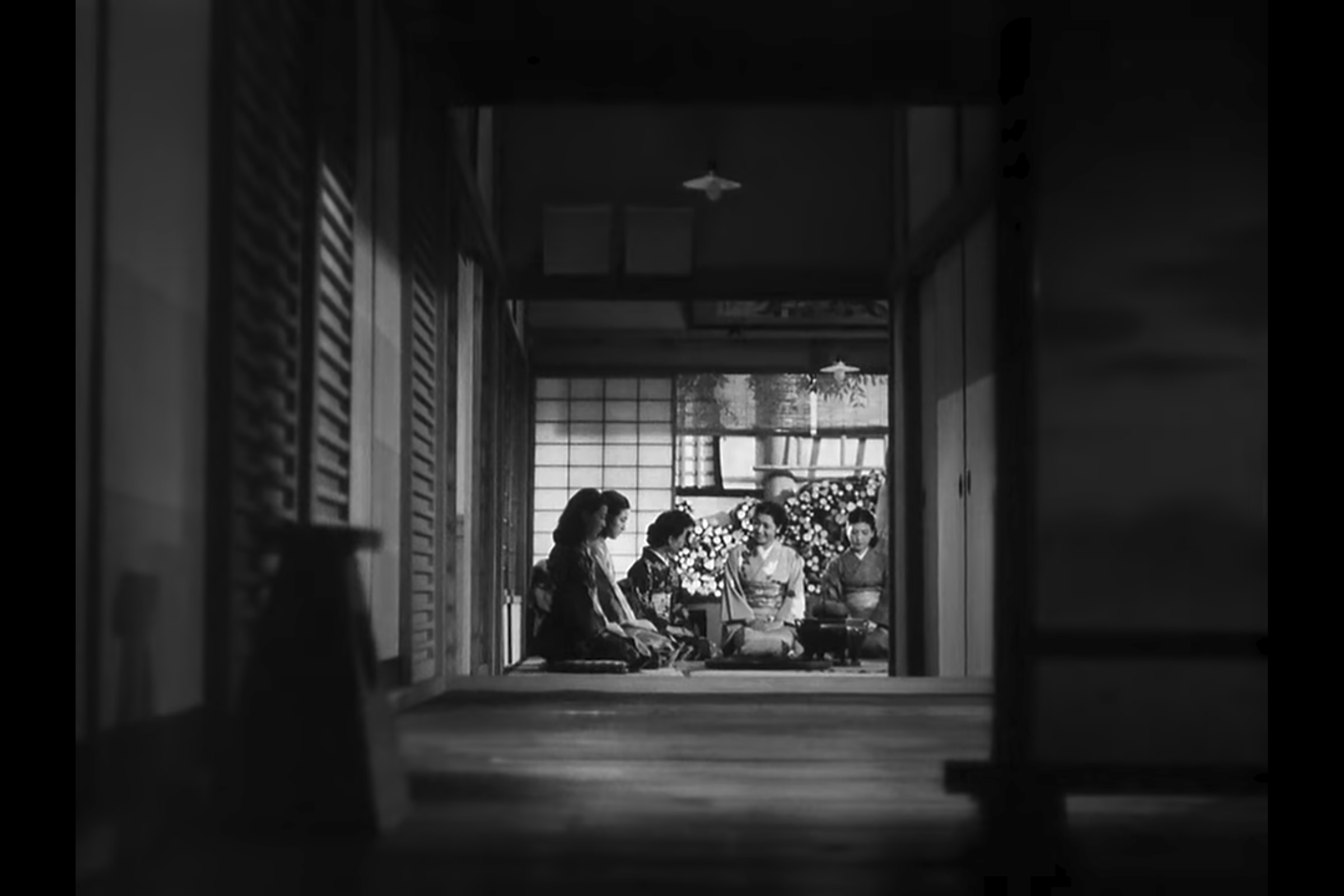
It is a small thing, Western-style, and she becomes self-conscious about it almost immediately. This object does not belong here. She tucks it beside her, half-hidden. Nobody else seems to notice. The ceremony continues. But the incongruity has been registered, and Yasujiro Ozu’s camera has made sure we registered it too.
The young woman is Noriko, played by Setsuko Hara with a radiance that makes her eventual sadness almost unbearable. The film was made during the American occupation of Japan, two years after a new Constitution had come into force and reshaped Japanese political and social life. It is saturated with small incongruities like the purse: a "Drink Coca-Cola" sign glimpsed during a bicycle ride, a "Time-Life" billboard in Tokyo, a young scholar wearing a Western suit while his employer sits in a kimono. None of these are catastrophic. The new world does not announce itself. It simply appears, alongside the old one, and waits.
Ozu knew nothing about language models. But he understood what it looks like when a form of life is quietly replaced by another. And he understood something else, something I think the current discourse about AI has not yet learned: that the proper response to such a replacement is neither panic nor acceptance. It is something more difficult than either. The response is mourning, but in a sense that has almost nothing to do with grief.
The weight of tea
At the center of the film is a relationship between a widowed professor, Shukichi Somiya, and his twenty-seven-year-old daughter Noriko, who keeps his household running. Ozu gives the first half of the film to this relationship, with a patience that can feel, to a viewer trained on Western pacing, like nothing is happening. We watch Noriko prepare dinner. We watch her make tea. We watch her tease her father about forgetting things, hang up his clothes, move through the rooms of their house with a freedom that is also a form of devotion. He depends on her entirely, and the dependence runs both ways. The world they have built is not grand. It is made of tea and tidying and familiar jokes. It absorbs their attention, their care, their identities. It is a world. And Ozu spends an entire hour making us feel its weight so that we will feel its loss.
In one of the film’s early scenes, Somiya sits on tatami in his traditional house, working with his assistant Hattori on a paper about the German-American economist Friedrich List. Hattori wears a Western suit. The research belongs to a Western academic tradition. The house is Japanese.
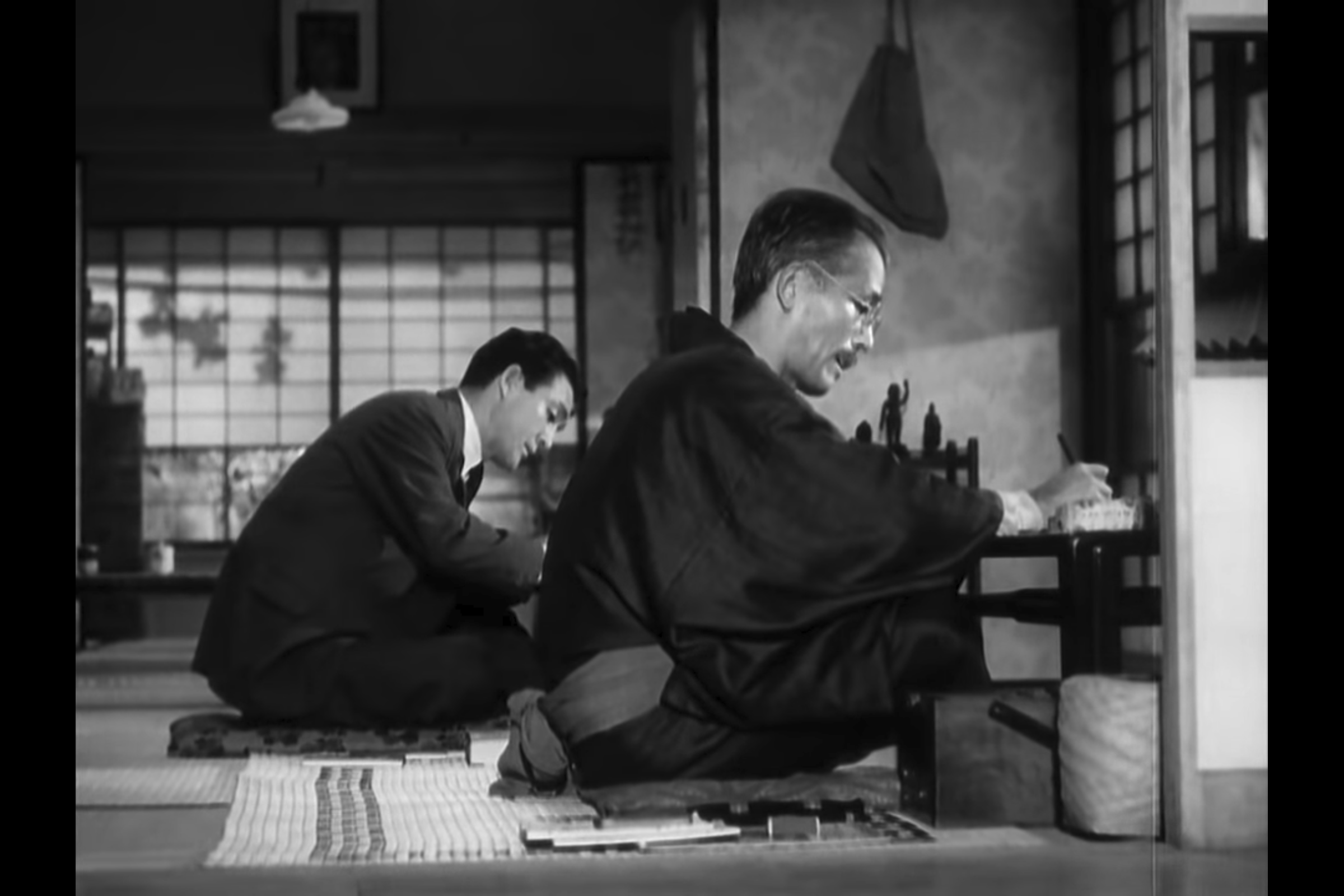
Two forms of knowledge share the same room, and neither has yet displaced the other. But the displacement is coming, and the professor’s body, positioned between tradition and modernity, already registers it. He is maintaining a community of judgment through embodied, situated, intellectually alive work: a man in a kimono, on a tatami floor, doing Western economics. The incongruity is Ozu’s signature.
Stanley Cavell once wrote that "any relationship of absorbing importance will form a world." What holds this one together, what holds any shared world together, is not a system or a structure. It is the daily, embodied attention of the people inside it. The willingness to notice that a sentence is not quite right and to sit with the discomfort until you understand why. The patience to read a student’s work slowly enough to feel where the thinking breaks down. The habit of care that makes someone check a source one more time, not because a rule demands it but because their name is attached to the result. Noriko makes tea. The world holds.
Persistence without force
The film’s turning point arrives during a Noh performance. Somiya and Noriko attend together. Noh is a practice of extreme formalization: precise movements expressing deep emotion through minimal gesture. There is an apt parallel with Ozu’s own filmmaking, which conveys its most profound feelings through the smallest shifts in posture or expression. The audience, in kimonos and suits, sits in respectful attention.
During the performance, Noriko notices a woman she knows: Mrs. Miwa, the widow who is being considered as a new wife for her father. Noriko’s response is barely visible. A subtle lowering of the head. A withdrawal into herself. It is enough.
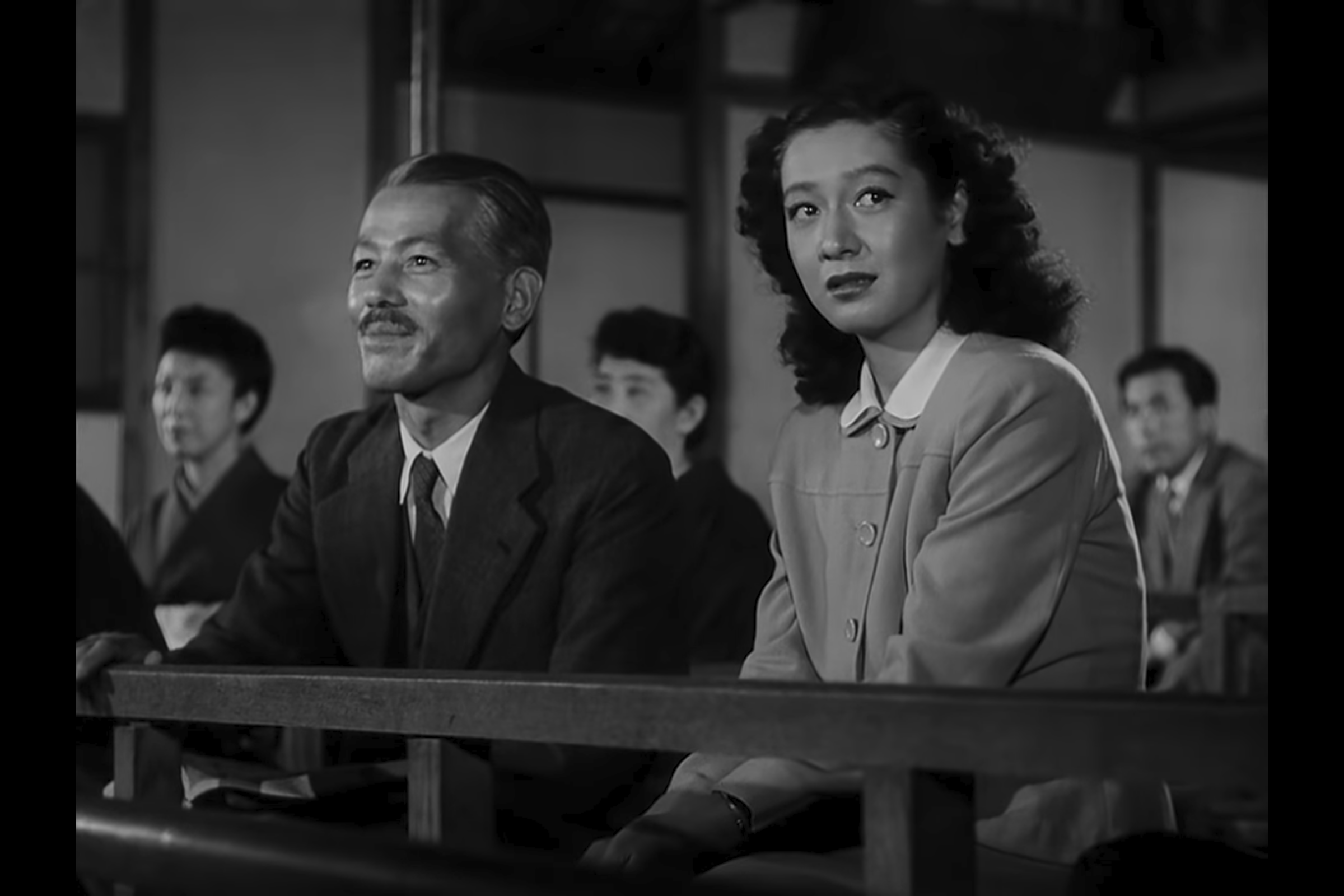
In that gesture, the daughter registers her father’s separateness for the first time: the fact that his desires may not be aligned with hers, that his happiness might require her loss, that the world they share is not guaranteed. She is discovering that the person closest to her is also, irreducibly, another person, with needs she cannot absorb into her own.
What stays with me now is what this scene also says about ritual itself. The Noh play continues. The forms are intact. But something has shifted in how the participants inhabit them. I once wrote that the traditional practices Ozu depicts are at the verge of becoming mere ritualized repetitions, or perhaps forms of mourning a world already felt as lost. The ritual does not vanish. It continues, hollowed, while the conditions that gave it meaning shift beneath it. The Noh play is still beautiful. Noriko is still sitting in the audience. But the world the play was made for, the world in which a father and daughter could sit together in untroubled intimacy and watch performers enact the old stories, is already receding.
Anyone who teaches, or has recently been a student, will recognize the feeling. A lecture hall in which the professor speaks and the students take notes still looks the same as it did twenty years ago. The room is the same. The postures are the same. The ritual persists. The world it was made for is receding, and, as I argued in What Won't Cross, the slow, formative practice of thinking does not automatically cross to a new medium. The students are half-present, their attention divided between the lecture and the devices in their laps, and the professor senses this without always being able to name it, and adjusts, simplifies, performs a version of teaching that accommodates the drift.
This is what persistence without force looks like. And this is where the film first teaches us what mourning might mean. Not grief for someone who has died, but the recognition that the world you inhabit with another person is not permanent. Love does not make two people one. Separateness is the condition of every genuine relationship. Noriko’s lowered head is the gesture of someone who is beginning to accept this, and the acceptance will cost her everything she has, and it is also, Ozu insists, the only path toward an adult life. Mourning is not the opposite of growth. It is its prerequisite.
Beyond ceremony
Late Spring builds toward a wedding that never appears on screen.
We see the preparation. Noriko stands in her room, now emptied of furniture, dressed in a traditional wedding kimono. Her face holds an expression that Setsuko Hara somehow makes legible as contentment, sadness, gratitude, and farewell simultaneously. She kneels before her father and thanks him for his care. He smiles and tells her to be happy. It is the last time we see them together.
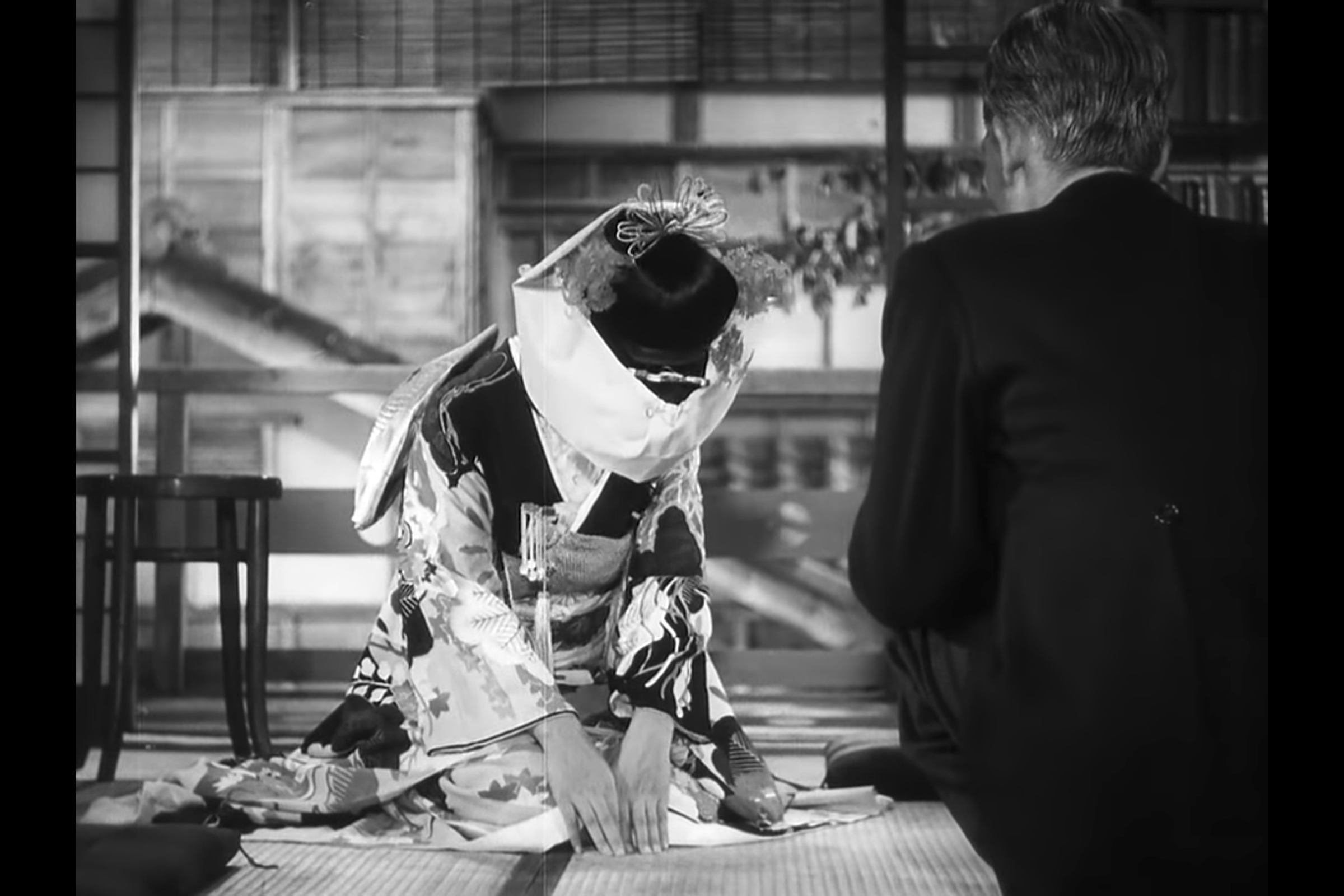
Then Ozu cuts away. The wedding ceremony happens offscreen. We are not shown it. We will never be shown it.
This is the film’s most radical gesture. A wedding is where shared meaning does its most visible, most ancient work. Two people stand before a witness. A community recognizes the act. A private relationship becomes a public fact. Every culture on earth has some version of this moment, and every version rests on the same fragile structure: it works because the people present agree to treat it as real, because they invest the form with their collective belief, because someone stands behind the words and means them. Take away the standing-behind and the ceremony becomes mere performance. The words are still spoken. The rice is still thrown. But the thing that made it a wedding (the human willingness to be bound) has quietly departed.
Ozu refuses to show the ceremony. Cavell helps me understand why. In his study of Hollywood remarriage comedies, Cavell noticed that classical comedy always ended with a wedding, celebrating society’s ability to provide continuity. But at some point, he wrote, "perhaps when the world went to war, society stopped believing in its ability to provide that continuity." The remarriage comedies respond by locating happiness not in ceremony but in the couple’s own "capacities for improvising a world, beyond ceremony." The guarantee is gone. What remains is the difficult, daily, never-finished work of forging a shared life out of nothing but your own willingness to keep forging it.
On the night before the wedding, in Kyoto, Noriko tells her father that she does not want anything to change. "Being with you is enough for me," she says. "Marriage couldn't make me happier." Somiya's reply is one of the most remarkable speeches in all of cinema:
"Happiness isn't something you wait around for. It's something you create yourself. Getting married isn't happiness. Happiness lies in the forging of a new life shared together. It may take a year or two, maybe even five or ten. Happiness comes only through effort. Only then can you claim to be man and wife."
A father who has spent the entire film being cared for by his daughter now tells her the deepest thing he knows: that happiness is not a state but a practice, not a destination but a labor, and that the labor takes years, and the years will be difficult, and the difficulty is the point. He is telling her what mourning actually opens onto. You accept that the world you had is gone. You accept that no ceremony can replace it. And then you begin the slow, uncertain work of forging a new one, knowing that this new world too will eventually be lost, and that the willingness to forge it anyway is the only happiness available to finite beings.
Following this conversation, in the silence of the Kyoto inn, Ozu inserts the famous vase sequence. As father and daughter lie on tatami mats, Noriko looks up. The camera cuts to a simple vase standing in the corner of the dark room, shadowed by the leaves of a plant. The shot is held in complete stillness for ten seconds. Then, a close-up of Noriko's face, her smile fading into sadness, and then the vase again, silent and still.
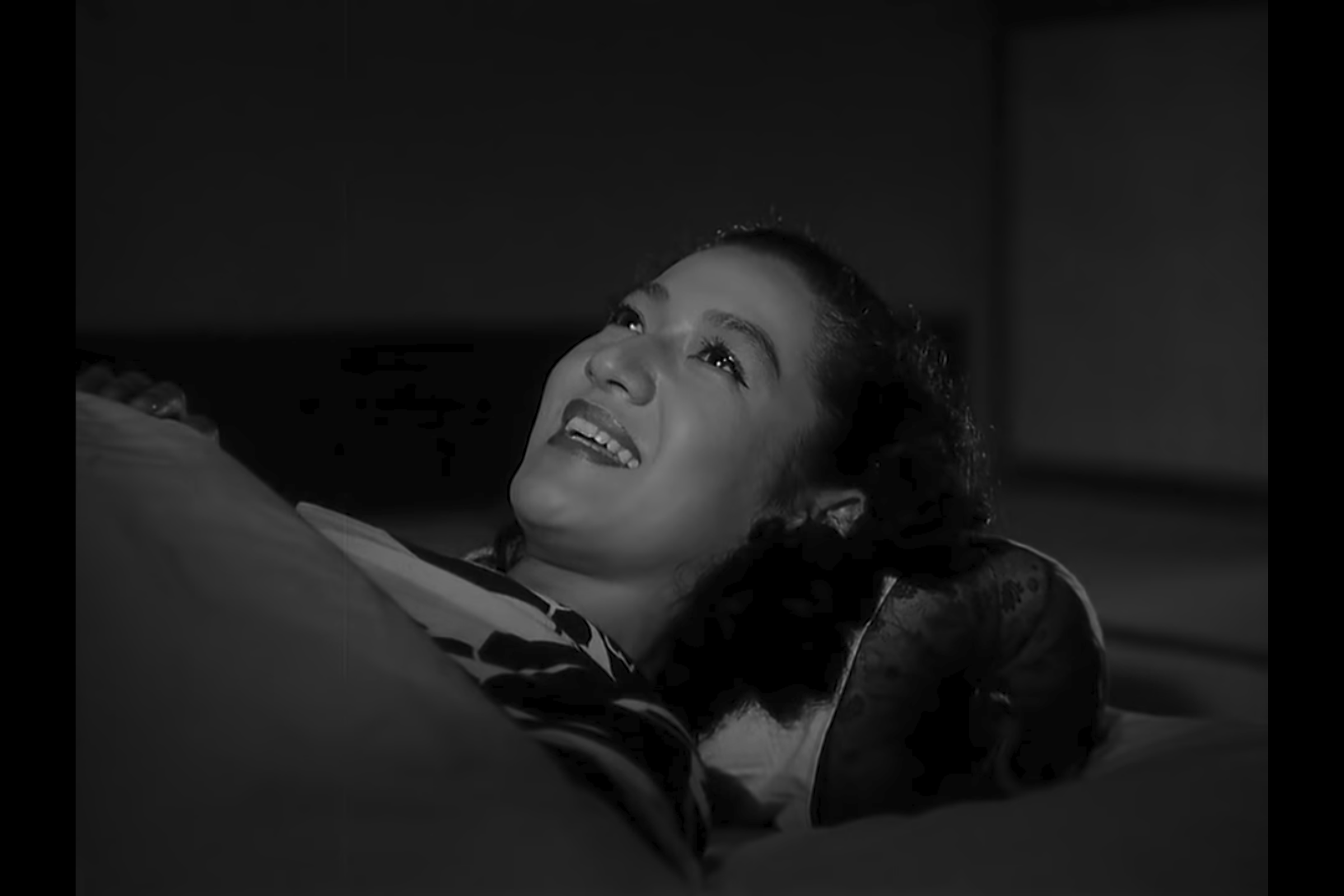
This sequence is the visual grammar of mourning. The vase does not do any work; it simply exists. By forcing us to look at it, Ozu shows us what Noriko is realizing: that the domestic world she shared with her father is already separate from her, that it exists only as it is being lost. In the silence of that room, the vase stands as a monument to what is about to be left behind.
This is the connection between Ozu’s film and our present that I find hardest to articulate, and most important to try. Somiya is not describing efficiency or optimization: the very forces that, when execution goes to zero, expand our orchestration to infinity (as I examined in The Jevons Paradox of the Self). He is describing what it takes to maintain a shared world: effort, over time, by beings who cannot know in advance whether the effort will succeed.
When AI systems take over the maintenance of institutional reality, that effort disappears. The outputs continue. The forms remain intact. Legal filings appear, correctly formatted. Medical summaries read as they should. Policy documents, research papers, editorials, all produced with impressive competence. But the system that produced the document does not bear the risk of its failure. It does not have a reputation that can be destroyed, a patient whose face it will have to meet, a professional community whose quiet judgment it fears. It does not need a year, or two, or ten. It does not forge anything. What we get is the ceremony without anyone standing behind it. The form without the forging. The wedding, performed to an empty room.
What the peel knows
After the wedding, Somiya returns home alone.
Ozu films him entering the house, standing for a moment in the doorway as if the space has become unfamiliar. He sits in a chair that used to be his daughter’s. The camera lingers on the empty rooms, the rearranged furniture, the corridors where Noriko used to move with such freedom. The absence is not stated. It is architectural. The house is the same house. It is no longer the same world.
Then comes what I believe is one of the most extraordinary uses of an ordinary scene in the history of cinema. Somiya sits and peels an apple. Carefully, slowly, trying to keep the peel in one piece. He fails. The peel breaks. He lowers his head.
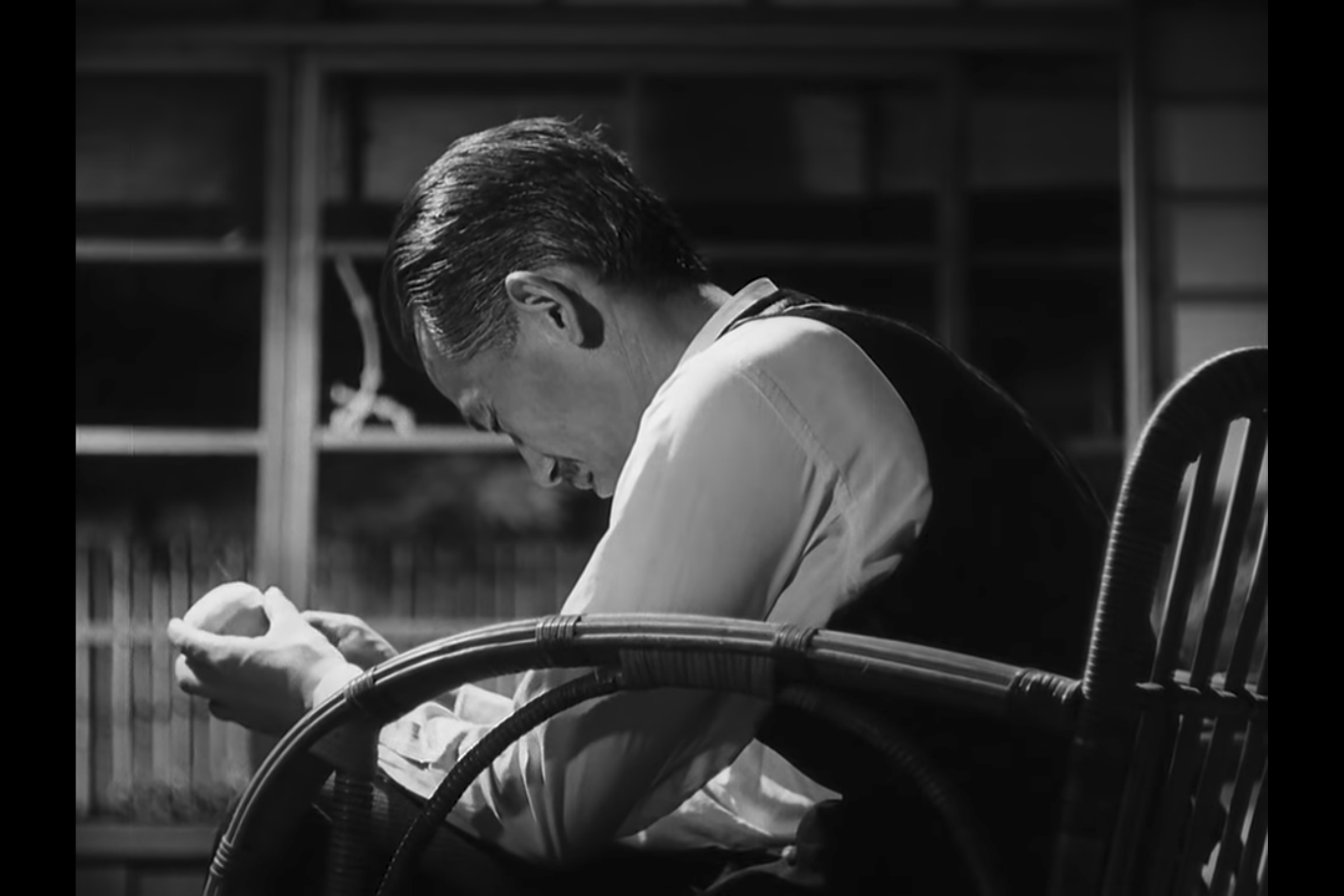
The film does not cut to the peel on the floor. The critic Andrew Klevan observed that the film does not cut to the peel falling onto the floor because it wishes to maintain the integrity of something lost from the frame and now unrecoverable. The camera stays on the man, on the failure, on the lowered head. It is the same movement Noriko made at the Noh play when she registered her father’s separateness. Father and daughter, in their separate moments of loss, make the same gesture. The echo is devastating.
The image is itself the argument: Somiya tries to keep the apple peel whole and fails. The peel falls and the film refuses to show us where it lands. What is being depicted is not an event but a condition: the condition of beings who try to hold together what is already falling apart, and who must go on living after it falls. This is mourning in its full sense: not grief, not nostalgia for a golden age, not a clinical stage that resolves into acceptance, but something more precise and more demanding.
Cavell, drawing on Thoreau, describes mourning as the path of accepting the loss of the world, accepting it as something which exists for us only in its loss. The everyday is not a stable ground beneath our feet. It is something we must continuously achieve, continuously maintain, and continuously mourn, because it is always already receding from us. He condensed it into a sentence I have returned to more times than I can count: "The everyday is what we cannot but aspire to, since it appears to us as lost to us."
This is not the familiar mourning that resolves when you find a replacement for what you have lost. It is an ongoing reckoning with the fact that the world is separate from us, that our connection to it is not guaranteed, and that maintaining that connection is our responsibility, not the world’s gift.
The happiness speech and the apple peel scene make the same thing visible from different angles. Mourning and forging are not opposites. They are two faces of a single activity. To forge a new shared world, as Somiya tells Noriko she must, you have to accept the loss of the old one. To accept the loss, truly, you have to be the kind of being for whom the loss is real, for whom the world was not a backdrop but a home, for whom the peel breaking is not a mechanical event but a private catastrophe. Mourning is what makes forging possible. It is the cost of admission to a genuinely shared life.
Somiya, peeling his apple alone in a house that is no longer his daughter’s home, inhabits this condition. He is not trying to get Noriko back. He sent her away. He is living inside the loss and learning, at fifty-six, what the ordinary costs when it is genuinely borne.
This is what AI cannot do. Not because it lacks feelings (that question remains open in ways that should make us uncomfortable). But because mourning requires finitude. It requires the capacity to lose something irreplaceable and to know it is irreplaceable. It requires a body that sits in a chair that used to be someone else’s, hands that try to keep an apple peel whole and fail, a head that lowers when the failure becomes real. A system that maintains shared reality without having a stake in its coherence, that keeps the forms running without knowing what it would mean for the forms to collapse: such a system cannot mourn. And because it cannot mourn, it cannot forge. It can produce, optimize, maintain, generate. But the forging that Somiya describes to his daughter, the labor of years, the happiness that comes only through effort: this requires a being that has something to lose. The shared infrastructure of meaning that holds civilization together was built by such beings. It was built by mourners.
I build these systems. I know their power.
And I know the difference between maintaining something and caring about it is the difference between a civilization that knows what it has and one that merely has it.
The waves at Kamakura
Late Spring ends with a shot of the ocean. Waves break on the beach at Kamakura. They are indifferent to everything that has happened. They broke before Somiya was born. They will break after everyone who watched the film is gone.
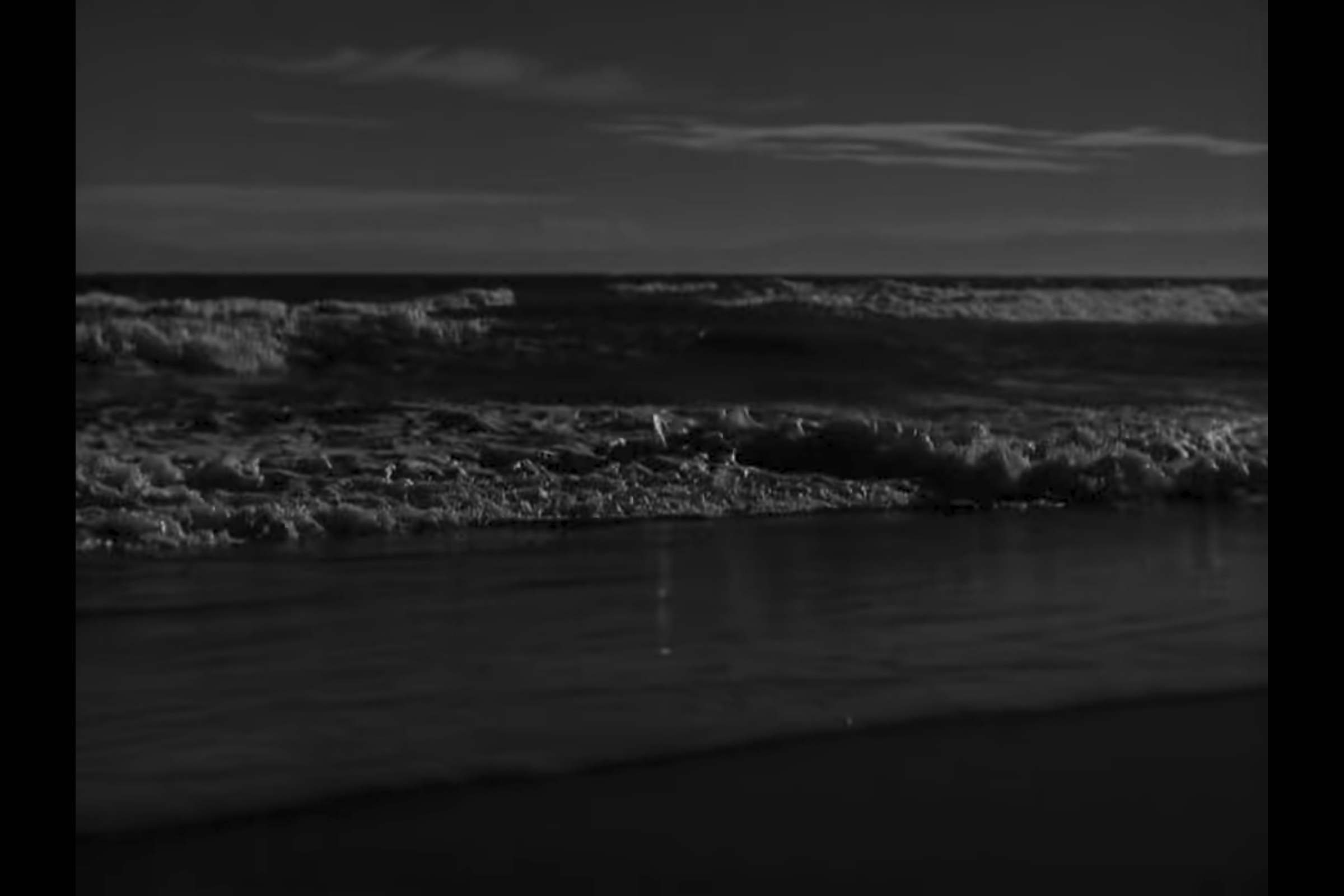
The deepest risk AI poses to our shared world is not catastrophe. But it is also not inevitable decline. This is the part that Ozu’s film understands and that most of the current discourse does not.
Noriko leaves. Somiya is alone. The apple peel breaks. And then: the waves. The film does not end with the father in his empty house. It ends with the ocean. With something that goes on.
Mourning is not a posture of defeat. Somiya told his daughter the truth: happiness comes only through effort, through the forging of a new shared life. He was preparing her not for loss but for what comes after it. For the difficult, uncertain, necessary work of building a world she cannot yet imagine. The mourning makes the forging possible. Without it, she would cling to the old arrangement forever. And the old arrangement, however beautiful, was a world in which she never had to become herself.
This is what the AI discourse is missing. Not just the recognition that something is being lost, though that recognition is urgent, and mostly absent. The recognition that the loss, properly mourned, could open onto something. The point is not that human error is valuable in itself, or that inefficiency deserves protection. It is that institutional reality is written into human flesh through the experience of getting it wrong.
A doctor who misdiagnoses a patient carries that error in her body. It is not abstract regret; it is a specific face returning at three in the morning when sleep will not come. It changes how she reads the next scan: slower, with a peripheral attention that no protocol taught her. It changes how she listens, leaning forward when a patient hesitates, hearing the thing that almost went unsaid. That weight is not a flaw in the system; it is the system. A lawyer who misses a precedent, a teacher who grades too generously: each carries the cost forward, and the cost becomes part of their attention, part of what makes institutional reality real. These are not inefficiencies. They are the scar tissue of forging. They are what mourning makes available.
A system that does this work without bearing these costs can be more accurate than any human practitioner and still hollow the institution it serves.
I know, because I helped design the purse.
The excellence is the problem: it makes the costs look like overhead, makes the standing-behind look like a bottleneck, makes the human weight of institutional maintenance look like something that will be engineered away.
And yet. The doctor who has worked alongside an AI diagnostic system and who understands, viscerally, what it means to carry a patient’s face home: that doctor practices medicine differently. Not worse, not the same, but with a kind of attention that has passed through the fire of comparison and come out changed. The teacher who has felt the ritual of the classroom hollow itself out and who has decided, nevertheless, to keep teaching, to find new ways to make the encounter real: that teacher is forging something. The lawyer, the journalist, the researcher who has reckoned honestly with what these systems can do and has asked, therefore, what only a finite, fallible, mortal practitioner can bring to the work: these people are not relics. They are mourners. And mourners, Ozu shows us, are the ones who build what comes next.
We are in our own late spring. The old forms of maintaining shared reality are still here. The new ones have arrived alongside them, quietly, competently. The purse is already at the tea ceremony. The question is not whether the transition will happen. The question is whether we will mourn it well. Whether we will do what Noriko does, what Somiya does, what the film itself does: accept the loss without pretending it is not a loss, and then begin the slow, uncertain, necessary work of forging the world that comes after. The waves break at Kamakura. They do not grieve. They do not forge. They simply continue. We are not waves. That is our burden. Ozu knew it is also our grace.
---
Sources & further reading
Yasujiro Ozu, Late Spring (Banshun, 1949). A film about what it costs to let go of the ordinary, told through the quiet dissolution of a father-daughter household in postwar Japan.
Stanley Cavell, In Quest of the Ordinary: Lines of Skepticism and Romanticism (1988). Contains the formulation "the everyday is what we cannot but aspire to, since it appears to us as lost to us" (p. 171), and the account of mourning as the path of accepting the world in its loss (p. 172).
Stanley Cavell, The World Viewed: Reflections on the Ontology of Film (1971). Contains the observation that "at some point, perhaps when the world went to war, society stopped believing in its ability to provide that continuity" (p. 79).
Stanley Cavell, Pursuits of Happiness: The Hollywood Comedy of Remarriage (1981). The argument that happiness must be found through the couple's "capacities for improvising a world, beyond ceremony" (p. 239).
Stanley Cavell, Must We Mean What We Say? (1976). Contains the formulation "any relationship of absorbing importance will form a world" (p. 118).
Stanley Cavell, The Claim of Reason: Wittgenstein, Skepticism, Morality, and Tragedy (1979). The philosophical source for the distinction between knowledge and acknowledgment, and the analysis of criteria as grounded in shared forms of life.
Jônadas Techio, "Mourning the Loss of the Ordinary: A Cavellian Reading of Ozu's Late Spring" (Aesthetic Investigations, 2020). The scholarly foundation for the film reading developed here, focusing on Cavell's diagnosis of skepticism and its cinematic expression.
John Searle, The Construction of Social Reality (1995). The formalization of institutional facts and the "X counts as Y in context C" structure that illuminates the absent wedding scene.
Andrew Klevan, Disclosure of the Everyday: Undramatic Achievement in Narrative Film (2000). The finest close reading of the film's visual grammar, including the observation that the film "wishes to maintain the integrity of something lost from the frame and now unrecoverable" (p. 159).
Tammy Clewell, "Cavell and the Endless Mourning of Skepticism" (Angelaki, 2004). The distinction between Freudian mourning (substitution) and Thoreauvian mourning (accepting the loss without recovery), which grounds the argument about AI and finitude.
Related essays