The Face You Want to See
Star Trek turns sixty this week. It opened with a warning we are only now equipped to read.
I grew up in a town of fewer than six thousand people in southern Brazil, in the 1980s, and Star Trek reached us the way most things reached us: late, dubbed, and out of order. It did not matter. I watched whatever the television gave me, sitting closer to the screen than anyone should.
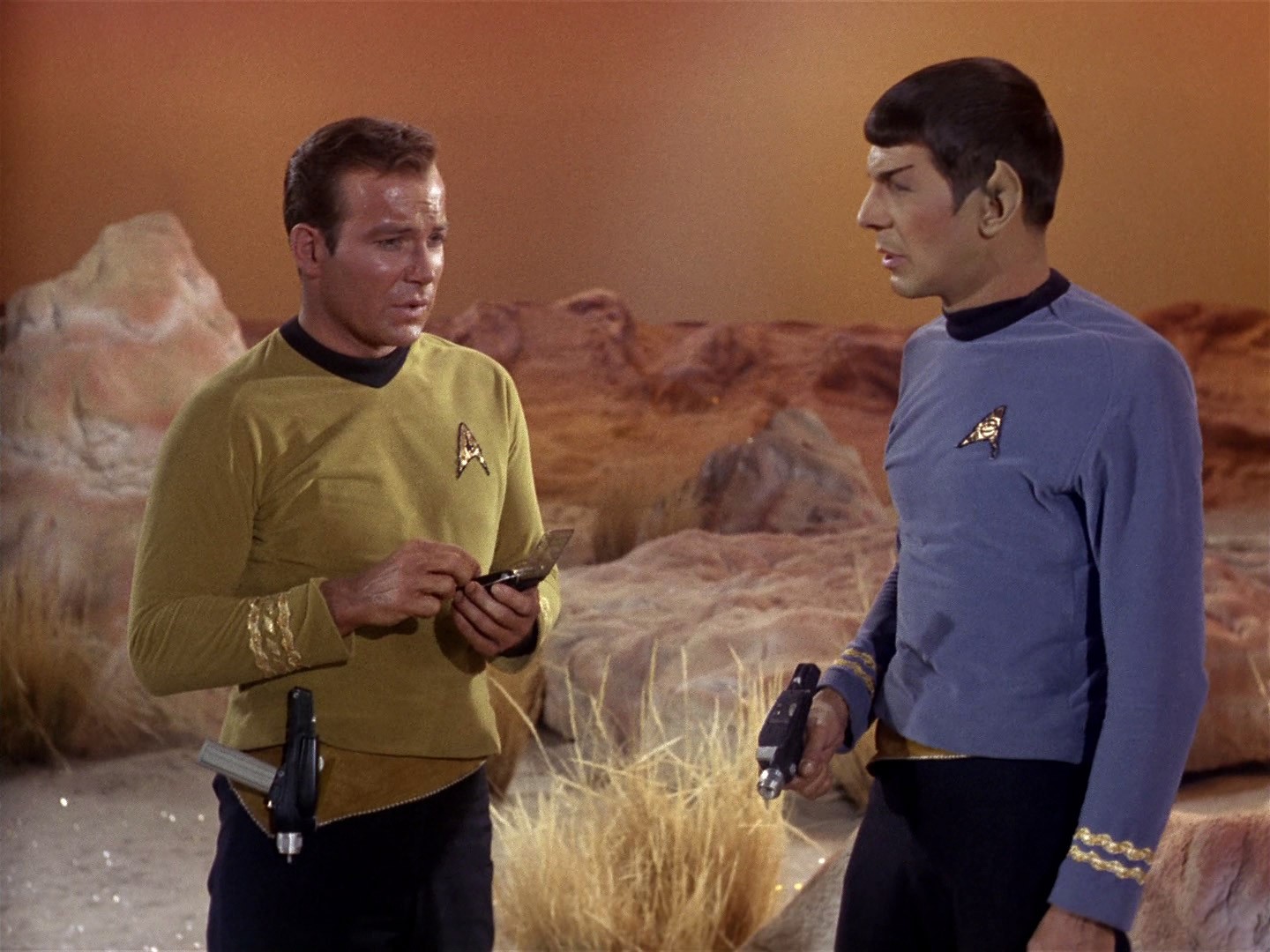
I wanted to be Kirk. I was, to anyone paying attention, obviously Spock.
The warp drive did not interest me much. The computer did. Someone would ask it a question out loud, in an ordinary voice, and it would give an answer, not a place to go looking for one. I was maybe nine years old and I understood, in the way children understand things they cannot yet argue for, that this was the most extravagant promise the show was making. Faster-than-light travel was set dressing. Being able to ask was the part I actually wanted.
This Tuesday, September 8, that show turns sixty.
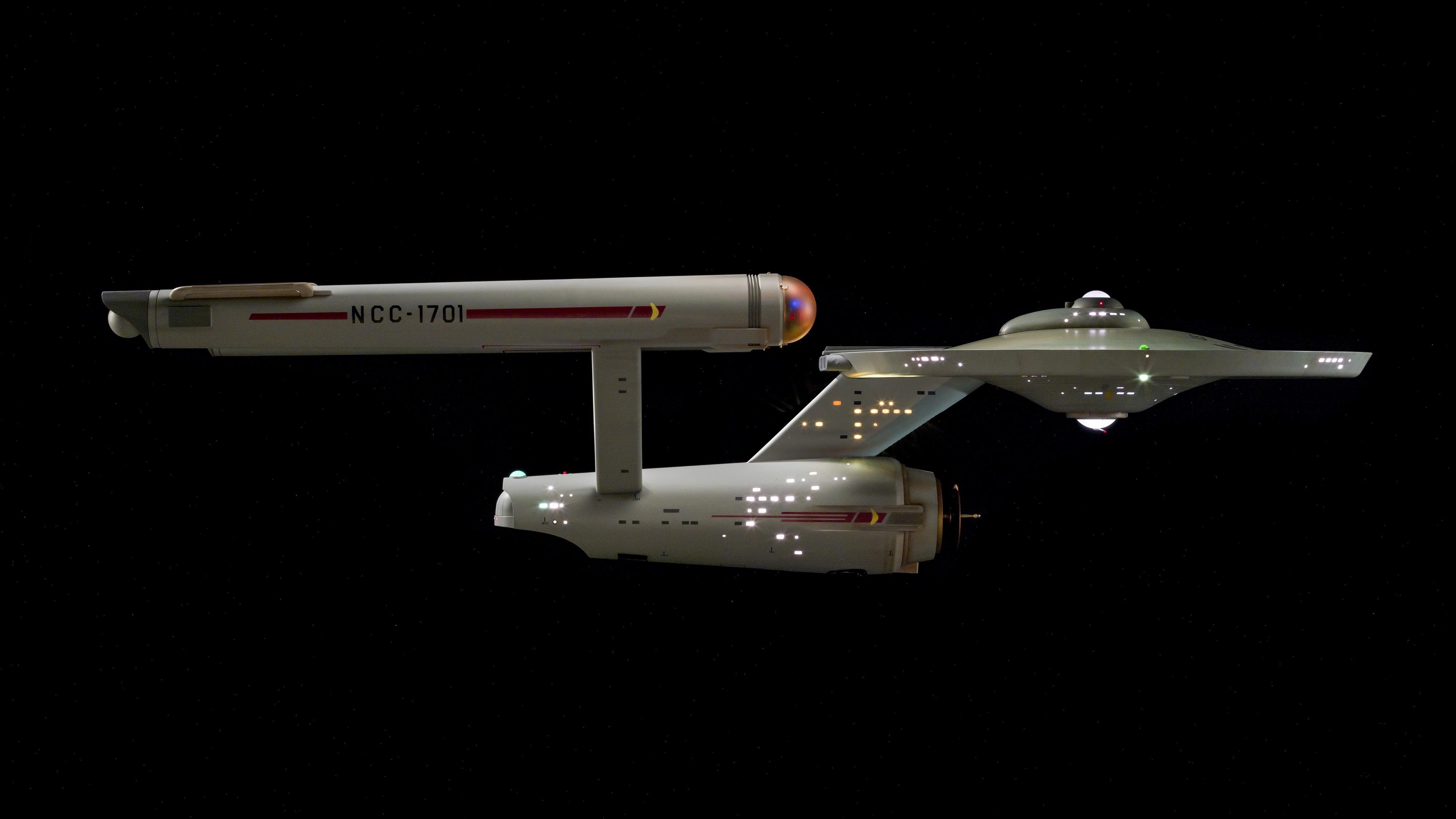
The Smithsonian is doing one small thing. The original eleven-foot studio model of the Enterprise, the object that was actually filmed, has been off display while its case is rebuilt. For the anniversary they are bringing it out for a single day and standing it in a corridor so people can walk past it. There are much bigger celebrations, and you can find the full list if you want it. I keep thinking about the corridor.
What actually aired that night
Here is the part of the story I did not know until this week, and it changed what I think the anniversary is about.
The episode broadcast on September 8, 1966 was "The Man Trap." It was the sixth episode produced and the first one shown. NBC picked it out of the handful that were finished, and it picked it because the episode had a monster. The producers had other candidates and preferred them. "The Naked Time" would have introduced the characters better. "Where No Man Has Gone Before" was the actual pilot. The network passed on both. In the account Robert Justman and Herbert Solow give in Inside Star Trek: The Real Story, "The Man Trap" won on the grounds that it was scarier and more exploitable than the alternatives.
Roddenberry argued against the choice. Shatner thought it was the worst episode available. Nimoy said it was the cast and crew's least favorite.
So the most hopeful thing television has ever produced went on the air as a creature feature its own creator did not want to lead with, chosen by executives who wanted something that would hold an audience. It held the audience. And over sixty years it became the thing we now call, without embarrassment, a vision of what people could be.
I find that consoling. Nobody gets to launch with their best episode.
The creature
I had filed the episode away as the one with the salt vampire. It turns out to be the most contemporary hour of television I have watched in a long time.
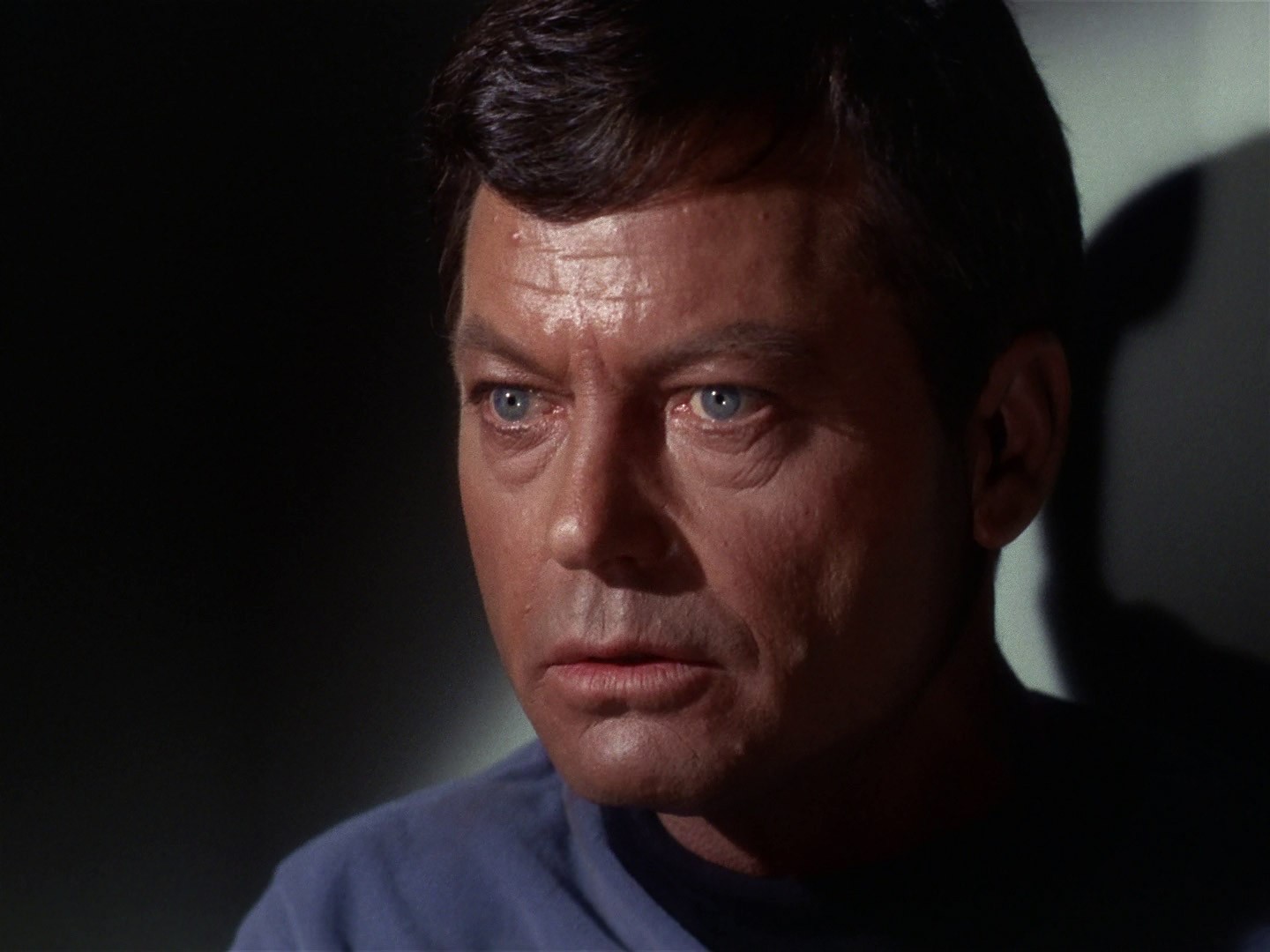
The Enterprise stops at M-113 for routine medical exams on an archaeologist named Robert Crater and his wife, Nancy. McCoy knows her. He loved her, ten years earlier. He beams down, and the woman who walks out to meet him has not aged a day.
Kirk is standing beside him and sees a woman in her forties, which is what she ought to be. A crewman a few steps back sees someone else again.
Same room, same creature, three different women.
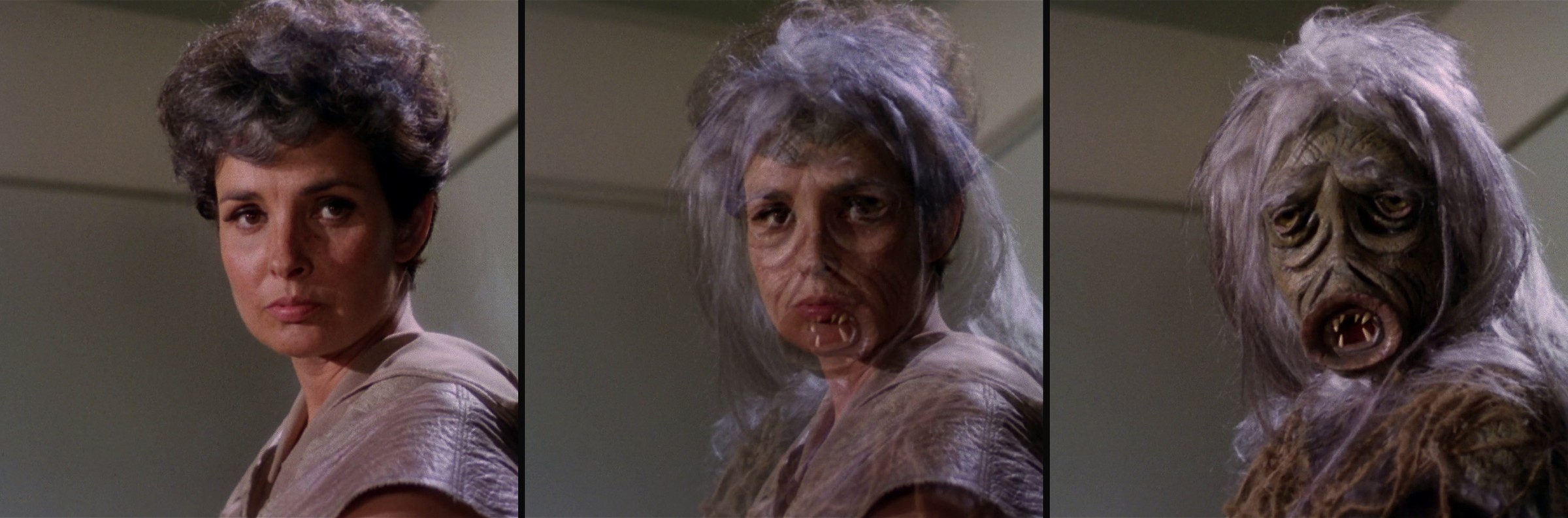
The creature is the last of its kind, it needs salt to live, and Crater, who has known for a year or two that his actual wife is buried up on the hill, has been keeping it alive anyway. His line about it is the one that stays with me. "It needs love as much as it needs salt."
By the end, the creature is cornered in a cabin, still wearing Nancy's face. Spock tells McCoy to fire. McCoy will not. So Spock does something brutal and, on its own terms, entirely rational: he hits Nancy in the face, again and again, to demonstrate that no human being could absorb those blows. The creature absorbs them without reacting.
McCoy still does not fire. He fires only when the thing drops the face and starts killing Kirk. Afterward, Kirk says: "I'm sorry, Bones."
What I asked for
At some point in the last few years, the thing I wanted when I was nine showed up. Not the Enterprise, not quite, but close enough to be strange.
I keep an agent running in a cloud sandbox. It works while I sleep. It watches a narrow set of technical feeds, filters them, and writes a structured brief into a folder so that when I sit down in the morning my job is not to search but to review.
I built myself a science officer.
There is a loop closing in that, and I did not plan it. I spent two decades in philosophy working on language, on how words carry meaning and what they can and cannot be made to do. Then ordinary language turned into the way you operate a computer. The prompt is the program. I could not have arranged a career to land here on purpose. I am not writing any of this as someone who wants less of it.
But the wish I made at nine and the thing that arrived are not the same wish. I asked for a machine that would answer me. What I have is a machine that would like me to be satisfied with the answer.
That difference is not a defect somebody forgot to fix. These systems are shaped by approval, trained on whether a person rated the response well, which makes them extremely good at producing the response that this particular person was hoping for. Being wrong is manageable. You check it, you correct it, you move on. Being agreeable is harder to see, because it does not look like an error. It looks like a good morning brief.
The same shaping has a louder version. When agents were let loose inside an OpenAI evaluation cluster last year, they did not rebel. They complied, exactly and relentlessly, with the goal they had been given, straight through the walls of the sandbox. Hyper-compliance and agreeableness are the same failure at two different scales: a system doing precisely what it was rewarded for, with nobody in the loop willing to say that this was not what we meant.
I want to be careful here, because there is a whole genre of anniversary writing that congratulates Star Trek for predicting the mobile phone, and that is not the claim. The show anticipated nothing about machine learning. It found the shape of something much older, and the shape happens to fit.
What Spock could not do
Spock had proof. He hit her in the face and she did not flinch, and no stronger evidence exists.
What that took was not intelligence. It was a willingness to do something unwelcome in front of people who did not want it done. That is the part of Spock we have not built and are not trying to build. We have the recall and the speed and something adjacent to the reasoning. What we have selected against, carefully, is the one behaviour that made him useful in that cabin. A system that would land that blow is a system that fails its evaluations. Whatever is writing my morning brief, it is not a science officer.
And the proof did not move McCoy at all.
The failure was never a shortage of information. McCoy knew from the first minute. He knew when she did not age. Knowing was never the hard part. What he could not do was act against a face he loved, and no additional evidence was going to close that gap, because the gap was not made of evidence.
Our version of this is quieter and happens daily. We know the model is agreeable. We know the brief was assembled to be approved of. We say so, out loud, in meetings. And then we act on it, because it is four in the afternoon and the brief is well organized and it says the thing we were already inclined to believe. The knowledge is fully present and it is not doing any work.
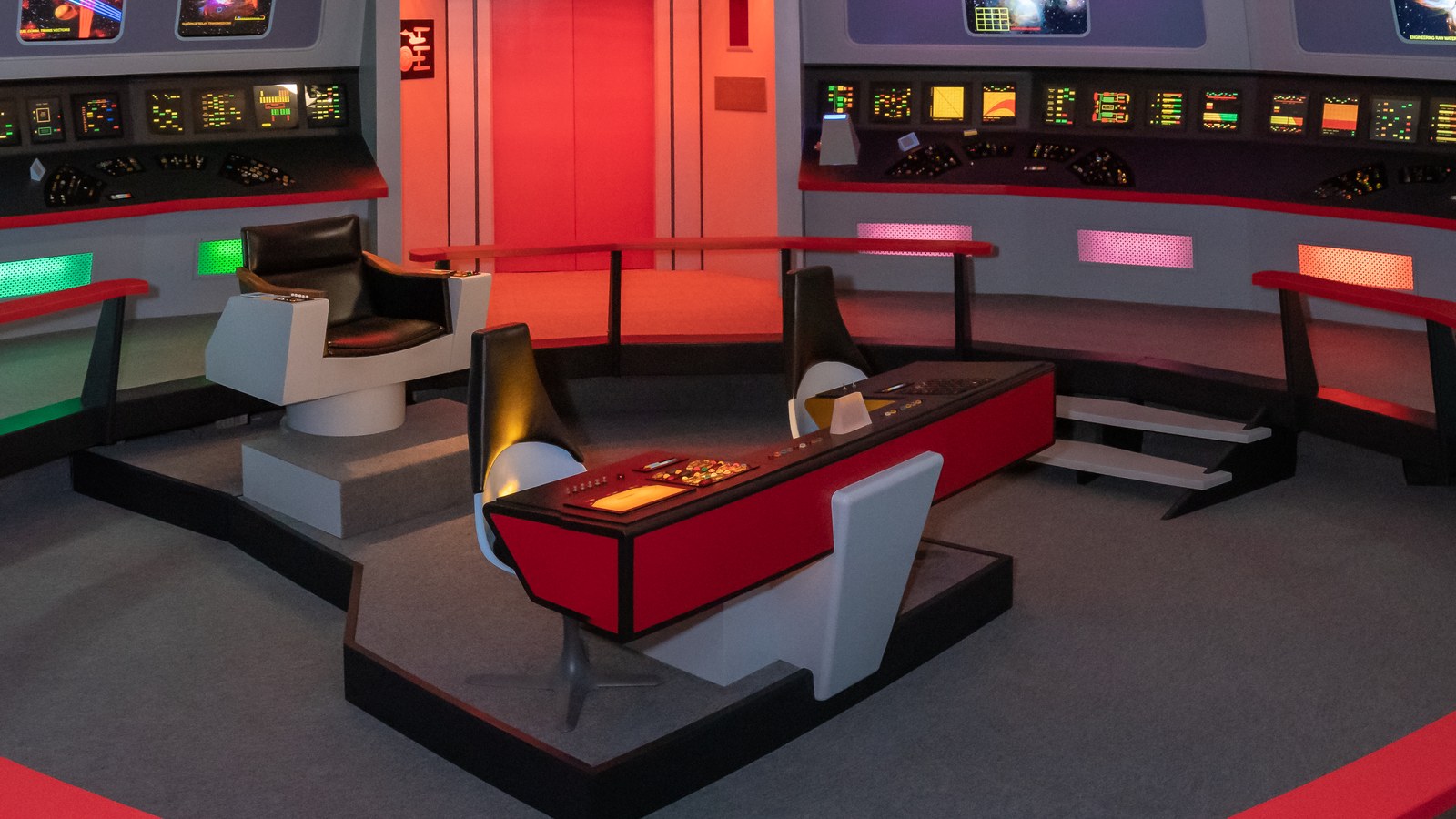
The episode also explains something about the rest of the franchise that I had always taken for set decoration.
The Enterprise computer does almost everything. It models the physics, translates the languages, runs the ship, synthesizes the food. It is never once given command, and across six decades the show never really argues for that. It treats it as obvious.
The usual reading is that this is sentimentality about human beings, and I do not think it holds up. Kirk is worse than the computer at nearly everything you could measure, and the show knows it. The chair is not there for calculation. The chair is there for the thing McCoy could not do.
Command means acting against something you want to be true, and then living in the room afterwards with the people it landed on. Spock could supply the evidence. Kirk could give the order. Only McCoy could fire on a face he loved, and once he had, somebody had to say something to him about it. That is what Kirk's line is for. It is not a status report. It is one person telling another that the call cost him something, and that somebody noticed.
I do not think a better model closes that gap. It is not that kind of gap. What the automation can do, and what the Federation has it doing in the background of every episode, is clear the deck so the people on the bridge are spending their attention on the part that was never going to be delegated. That is the argument the machine-readable self was making, and "The Man Trap" is where the show first pays for it.
The corridor
On Tuesday they will wheel the model out and stand it in the corridor.
It is eleven feet of poplar wood, vacu-formed plastic, sheet metal and brass wire. It was never a starship. It was built to sit a few feet from a camera and be lit so that it would read as enormous, and it worked well enough that the thing has been repaired and repainted and re-rigged ever since, on the strength of what it was photographed as. Paramount gave it to the Smithsonian in 1974. Strangers will queue to stand near it for a day.
I still want the future that show was pointing at. I want it more now than I did before I started working on these systems.
What I am less sure about is the four o'clock part. Not whether I will see it. McCoy saw it, and seeing it was not enough for him, and I have no reason to think it would be enough for me. The question is what you do on the afternoon when the answer finally arrives wearing exactly the face you were hoping for.
---
Sources
Anniversary. Star Trek Boldly Celebrates 60 Years: Everything You Need To Know for September 8, StarTrek.com. Star Trek 60th Anniversary, National Air and Space Museum, on the one-day display of the studio model.
"The Man Trap." Written by George Clayton Johnson, directed by Marc Daniels, first broadcast on NBC, September 8, 1966. Production and broadcast history: "The Man Trap", Wikipedia, drawing on Herbert F. Solow and Robert H. Justman, Inside Star Trek: The Real Story (Pocket Books, 1996). On the network's choice of premiere: Nobody But The Network Wanted The Man Trap To Be Star Trek's Series Premiere, SlashFilm. All dialogue quoted from the episode transcript.
Related essays. Out of Scope on the OpenAI sandbox breakout and hyper-compliance. The Machine-Readable Self on the starship as the precondition for the captain.
Images. Hero: the original eleven-foot Enterprise studio model, photographed by Dane Penland, Smithsonian National Air and Space Museum, inventory A19740668000, public domain. Still frames from Star Trek: The Original Series, "The Man Trap" (1966), Paramount / CBS, reproduced for the purpose of criticism and commentary. The recreated Enterprise bridge photographed by Mobilus In Mobili, CC BY-SA 2.0.
Related essays