Part 1 in What Remains? series
What Remains When the Job Comes Apart?
Labor, work, and the bluff AI just called on the modern job.
Early in Frank Capra's Mr. Deeds Goes to Town (1936), Longfellow Deeds, a small-town man who co-owns a tallow works, writes rhymes for greeting cards, and plays the tuba in the Mandrake Falls band, learns that an uncle has left him twenty million dollars. A few scenes later he is living in a mansion in New York, surrounded by a valet, a butler, bodyguards, and lawyers who want his power of attorney. Nobody there needs anything from him except his signature.
One night, coming back to that enormous hall, Deeds leans over the marble banister and calls out, just to hear his voice bounce back. Then he gets the valet and the butler to try it too. It is played as comedy, and it works as comedy. Underneath the joke sits a quieter picture: a man whose every material problem has just been solved, testing whether anyone, or anything, still answers him.

Earlier, sitting on a bench in Central Park, Deeds had already said it out loud: "People here are funny. They work so hard at living they forget how to live."
I want to start this series in that hall, because a growing number of us are about to walk into it. Not because we will inherit twenty million dollars, but because the things we used to be needed for are being done, faster and cheaper, by something else.
The thing that is changing
The job, the full-time salaried contract that packages income, schedule, and social standing inside one organization, is a recent arrangement, roughly two hundred years old, and AI is compressing the costs that made it necessary. I made that case in The Parenthesis of the Job, which ended at the door of a question it did not try to answer: if the parenthesis closes, what is on the other side?
This four-part series (What Remains?) began as a talk at UFRGS earlier this year, staying longer with the question it left open: if machines can soon perform most of our labor and a growing share of our work faster and cheaper than we can, what is left for us to do, and what happens to the dignity we used to draw from being needed?
Start with what is actually happening, and how quickly it moved over the past year. When OpenAI introduced GDPval in September 2025, a benchmark built from real deliverables across 44 occupations and graded blind by professionals with an average of 14 years of experience, the leading model (Claude Opus 4.1) matched or beat human experts on 47.6 percent of tasks (arXiv:2510.04374). Three months later, GPT-5.2 reached 70.9 percent. By March 2026, GPT-5.4 matched or beat the professionals 83.0 percent of the time.
These were not puzzles; they were reports, financial models, plans, and slide decks. Nor is the shift confined to benchmarks. In its January 2026 Economic Index, Anthropic reported that 49 percent of occupations had already seen Claude used across at least a quarter of their constituent tasks, up from 36 percent in its initial baseline.
Benchmarks exaggerate and age fast. What strikes me is not the score, but the direction of travel. For two centuries we told ourselves that machines would start at the bottom, with muscle and repetition, pushing people upward into the work of the mind. What we are seeing runs the other way. The text, the code, the analysis, the formatted document: the durable products of white-collar work are what the machines got good at first.
The person who cleans the office after everyone goes home is, for now, harder to replace than the person who writes the quarterly report.
The labor-market data are starting to catch up. In Brazil, Daniel Duque (FGV Ibre, April 2026) notes that almost 30 million workers, 29.6% of the employed population, are in occupations exposed to generative AI, with early employment and income effects concentrated among ages 18 to 29 (Duque, Blog do Ibre). Exposure is not loss, and he says so. In the United States, payroll records from millions of workers show employment for ages 22 to 25 in the most AI-exposed occupations running about 19 percent below trend, mostly from firms hiring fewer young workers rather than firing them, while experienced workers show no comparable gap (Brynjolfsson, Chandar, and Chen, Stanford Digital Economy Lab, August 2026 update).
The first rung is where people learn the work.
The mathematician Terence Tao put his finger on what makes this shift unusual. Traditionally, he told Tyler Cowen in November 2026, "when a mathematician created a paper, they also created a skilled author who could then give talks about that paper." Now AI systems "have unbundled the PDF, the actual physical paper, from the penumbra of more social or intangible values of that paper" (Conversations with Tyler, ep. 296). What used to arrive as one package is coming apart.
Labor, work, and the job
To say what exactly is changing, I need a vocabulary sharper than the single word "work." The one I find most useful comes from Hannah Arendt's The Human Condition (1958). I'll use her three terms in a deliberately plain version, and I'll try to say where that plain version cuts corners.
Labor is what we have to do to stay alive: feeding ourselves, keeping warm, cleaning, caring for bodies. Its products are consumed almost as soon as they are made, and then it starts again. Arendt ties it to the body's exchange with nature; it never ends, it only repeats.
Work is making things that last: a table, a bridge, a book, a building. It has a beginning and an end, and its product stays in the world after the maker walks away. Together, such things make a world stable enough for mortal lives to happen in.
Think of the difference between cooking dinner and building the table you eat it on. Dinner disappears tonight and must be made again tomorrow; the table stays in the room for decades and gives a household a place to gather. In modern offices the line is harder to spot, yet it is still there. Spending years writing a book like The Threat of Solipsism, designing a software architecture that will still be running five years from now, or shaping a seminar that changes how students read: none of that keeps a body alive, yet each leaves a durable artifact standing in the world after the maker walks away. Compare that with the weekly status decks, compliance checklists, and summary memos that vanish into a folder the Friday after they are sent.
Here I have to be careful. It is tempting to say that most of what people do in offices is work in this sense, and Arendt doubted it. She thought the modern division of labor had turned much of what looked like making into labor: tasks split into steps, done for a wage, used up by the next step in the process, leaving nothing behind that anyone would call a thing. In her words, the artist "strictly speaking, is the only ‘worker’ left in a laboring society," and she goes on to note that current theories dissolve even the artist's work into play (pp. 126–27). A quarterly report may be closer to labor than to a table.
Action is the hardest to define and the one I care about most. Arendt describes it as acting and speaking among others, in public, in a way that shows who we are rather than what we are. In this series I focus on a narrower piece of it, answerability: the capacity to stand behind something you did or made when someone asks you why, and to keep giving reasons when they push back, among others who can also begin something and answer back.
That is less than Arendt meant. She was after appearing before others and disclosing who you are, and I don't claim that full political weight for it at the start. Answerability is simply the part of action that AI puts under pressure first, and it is where the rest can begin. By Part 4 I will also want it to reach further than Arendt allowed, into matters she kept out of public life.
Then there is the job. Arendt doesn't count it as a fourth activity, but she does name it. Near the end of the book she describes "the last stage of the laboring society, the society of jobholders," which "demands of its members a sheer automatic functioning" (p. 322). I want to take her term one step further.
The job is not a kind of activity; it is a bundle. It pays the wage that takes care of labor, fills our days with work (or with labor that passes for work), and hands us an identity that stands in for appearing before others. When a stranger asks "What do you do?", we answer with a role, a what, and the answer works well enough that we stop noticing it isn't a who. Even when I stand up to lecture about this very subject, I catch myself introducing myself through my job without thinking.
I still remember the day I first felt what that bundle costs. On my first day as an appointed professor at UFRGS, the graduate program secretary, someone I had known since my undergraduate years when I had been her scholarship student, congratulated me warmly: you're set now, she told me; you have a guaranteed job until you're seventy. She meant it as a celebration, and by the lights of a Brazilian federal university it was one. To me it sounded less like a gift than a sentence.
Was I going to spend the rest of my life doing the same thing in the same place? I stayed eleven years, and when I left, the department staff were surprised. Almost nobody outside the department was; my wife told me she was surprised I had lasted that long. I wasn't running from security. I wanted room to grow, and the contract that guaranteed the wage also fixed the ceiling.
| Labor | Work | Action (answerability) | The job | |
|---|---|---|---|---|
| What it is | What we do to stay alive | Making things that last | Standing behind what you did when asked why | A bundle of the other three |
| Rhythm | Cyclical; it only repeats | Has a beginning and an end | Starts something nobody fully controls | Clock, career ladder, retirement |
| Examples | Cooking, cleaning, caring for bodies | A table, a bridge, a book, a software architecture | Speaking up, teaching, defending a cut | "What do you do?" |
| What AI changes | Little, for now, in the physical parts | Takes the procedural steps that had turned work into labor | Cannot stand behind a result for us; may crowd out the rooms where we are asked why | The bundle loosens |
Seen this way, what AI is doing becomes easier to describe, and it isn't quite what the usual story says. Robots that fold laundry and cook dinner are still clumsy and expensive. What AI is taking over first is the part of work that had already become labor: the steps we had made procedural, repeatable, and checkable. In The Machine-Readable Self I argued that machines can replace us exactly where what we did had already been mechanized. In Arendt's terms, that is work that slid into labor long before any model arrived. And because the job tied all of it to income and identity, pulling on that thread tugs at the whole bundle.
That suggests a different picture from the usual one. The usual hope, and the usual fear, is that machines will take labor and then work, leaving us either jobless or free for action. I think a third outcome is possible, and more interesting. AI may take over the labor, including the labor hiding inside our jobs, and give us a chance to go back to work in Arendt's sense, and to change it.
Heidegger helps me say why this won't happen on its own. In "The Question Concerning Technology" (1954) he describes how modern technology does not bring things forth so much as challenge them forth, revealing everything as standing-reserve: the river as a supply of hydroelectric power, the forester on call for the paper industry, and in the end people as human resources. He calls this way of revealing enframing (Gestell).
Against it he sets an older sense of making, the Greek technē, a kind of bringing-forth (poiēsis). In "The Origin of the Work of Art" his example is a Greek temple. Just by standing there, it gathers a world around it and lets things show up as what they are. You do not need a marble temple to recognize the contrast. A kitchen table, a carefully argued book, or a piece of software built with conviction gathers attention and changes the room it sits in; a slide deck generated only to clear a metric treats both the reader and the author as inputs in a pipeline.
Both paths are open. If we meet AI inside the frame, as a cheaper way to extract deliverables from resources that happen to include us, it will finish the conversion Arendt described, and what's left of work will be labor at machine speed. If we use it to clear away the labor, we may get back the part of work that was always about bringing something into the world and standing behind it.
A bluff that was called
Here a puzzle appears that I think is worth slowing down for. Arendt wrote her famous warning about automation in the prologue to The Human Condition, and she did not describe a society of workers losing their work. She described a society of laborers:
"It is a society of laborers which is about to be liberated from the fetters of labor, and this society does no longer know of those other higher and more meaningful activities for the sake of which this freedom would deserve to be won." (Prologue, p. 5)
Why laborers, if what she saw in the factories was the making of things? A few lines later she gives the answer herself:
"Even presidents, kings, and prime ministers think of their offices in terms of a job necessary for the life of society, and among the intellectuals, only solitary individuals are left who consider what they are doing in terms of work and not in terms of making a living."
I read this as a story in two acts. In the first act, the one Arendt was diagnosing in 1958, nobody had taken work away from us. We had done something subtler: we had started to justify all of our activity, including the making of lasting things and even public office, as a way of making a living. Work survived, but it was understood as labor. What counted was the paycheck at the end of the month and the output on the dashboard.
The second act is ours. If the value of writing the report really was only that it lands on someone's desk at the lowest possible cost, then a machine that produces it in seconds wins, and there is nothing to argue about. AI did not invent that way of valuing work. It called the bluff.
Even if jobs do not vanish altogether, the economist Jon Steinsson has suggested a quieter outcome: not automation, which implies a job apocalypse, but commoditization, which implies plentiful white-collar jobs emptied of scarce skill and paid accordingly, the pin factory and the fast-food counter moving up into technical roles. In Arendt's vocabulary, that is the final conversion of work into labor. Whether we remember the difference is up to us.
That is why so much of the anxiety about AI and jobs feels slightly off target to me. People will lose income or bargaining power, and that is a political problem we will have to solve politically. Underneath it sits a second worry that money alone will not settle. If the job was how many of us knew we mattered, then watching the bundle come loose is not only a threat to a salary. It may also be the first chance in a long time to find out which part of what we did was work at all.
What the bundle was holding up
The social psychologist Marie Jahoda spent much of her career on this second worry. Starting with her study of the unemployed village of Marienthal in Austria in the early 1930s, she argued that employment does five quiet things besides paying a wage (Employment and Unemployment, 1982, ch. 3, pp. 29–32). It imposes a time structure on the waking day; it forces regular contact with people outside the immediate family; it links us to a collective purpose larger than private concerns; it hands us a recognizable status and identity; and it supplies enforced activity, pulling us into motion even on mornings when we would rather stay still. Even people who hate their jobs lean on those five beams without noticing them.
Alexander Payne's About Schmidt (2002) is a cruel and funny picture of what happens when the paycheck stays and the rest goes away. Warren Schmidt retires from an insurance company in Omaha with a pension that covers everything. A few days later he drops by the office to offer his younger replacement some help, is politely brushed off, and on his way back to his car passes a row of dumpsters where his carefully labeled file boxes sit crumpled and soggy from the rain. Labor is taken care of. What he thought was work, something durable that the world needed, turns out to have been, as far as the institution was concerned, maintenance.
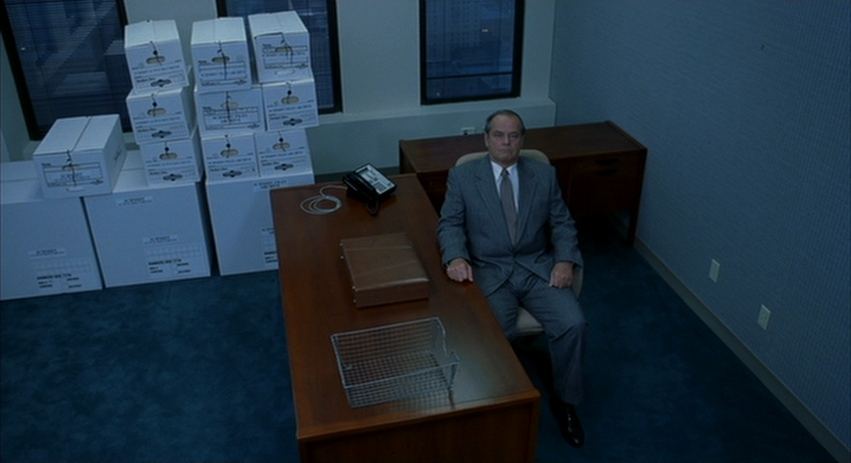
Many jobs are bad, and the shade of an office is no substitute for a meaningful life. But Deeds in his echoing hall and Schmidt by the trash point at the same thing. Being freed from necessity clears the room and leaves you standing in it.
I saw a quieter version of this more than once at the university. In a Brazilian federal university, many of the people who keep things running are career civil servants, professors and staff, who stay in the same institution for decades. Some of them spent forty years or more doing one thing, and doing it well. Then they retired. A few found something else to pour themselves into. But I also watched colleagues who seemed to lose the thread: the pension arrived every month, the days were free, and the thing that had organized their lives for four decades was simply gone. Nobody had prepared them for that.
I should be honest about whom these pictures leave out. Deeds has twenty million dollars and Schmidt has a pension. Most people whose jobs are automated away will have neither, and for them the first problem will be precarity, not vacant time: rent, debt, a second gig that pays less than the first. That is a question of income and institutions, and this series will not settle it. But it is worth noticing what Deeds himself does with the money once he finds his voice. He gives it away as two thousand small equipped farms for families ruined by the Depression, on the condition that they work the land for three years.
So, what remains?
Arendt's prologue ends with a sentence that is easy to skip: "To these preoccupations and perplexities, this book does not offer an answer." I find that honest.
Suppose the trend continues. Suppose technology takes over most labor, including the labor hidden inside our jobs, and the bundle gradually dissolves. Freed time can move in three directions. It can become more of the same, filling unscheduled hours with consumption, feeds, and what Arendt called the animal laborans's spare time (Part 2). It can turn freed ambition into a ladder without a building, a sharper war over status and relative rank once career ladders compress (also Part 2). Or it can open space for work given back and room for action: slow, formative craft that builds human judgment, and public rooms where we stand behind what we do (Parts 3 and 4).
I'll say now which one I'm hoping for, so it doesn't look like a trick at the end. My first instinct was that delegating much of our labor, and even our work, to technology could leave more room for action. I would put it differently now: handing over the labor, including the labor hidden inside our jobs, could give us back our work in a better form, and with it more room for action. Neither outcome will come inevitably or naturally. We have to do something to make it possible. That is a bet.
If you want the most practical version of that question before reading further, try a five-minute audit on your own week. Make two columns: what you have already handed over to AI, and what you still refuse to hand over. On my own list, the left column grows every month: first-pass summaries, bureaucratic forms, routine scaffolding, boilerplate drafts. The right column is smaller and sharper: deciding which argument holds up, cutting the fluent paragraph that does not belong, choosing what a product is for, and standing in front of colleagues or readers to defend a call when someone pushes back. What remains is what you can still, today, take responsibility for. A model can produce the text or the deck; if you sign it, you are the one who has to say why.
Deeds, eventually, stops calling into the empty hall and stands up in a full one.
Next in the series · Part 2 of 4 (Tuesday, December 1)
The Ladder Without a Building. Phil Connors at 6:00 a.m. in Punxsutawney, retirement and basic-income data, why Maslow's pyramid breaks above the base, ornamental ladders, and how status ambition moves into Kojève's snobbery or Fukuyama's struggle for struggle.
Followed by Part 3 · Why We Will Need Intellectual Gyms (Dec. 8) and Part 4 · What the Machine Cannot Sign (Dec. 15).
Sources
- Jônadas Techio, "The Parenthesis of the Job" (2026) and "The Machine-Readable Self" (2026).
- Frank Capra, Mr. Deeds Goes to Town (Columbia Pictures, 1936).
- OpenAI, GDPval (Sept. 2025; arXiv:2510.04374) and "Introducing GPT-5.4" (Mar. 5, 2026: 83.0% wins or ties on GDPval vs. 70.9% for GPT-5.2 and 47.6% for Claude Opus 4.1).
- Anthropic, "Anthropic Economic Index report: Economic primitives" (Jan. 2026: 49% of occupations using Claude for at least 25% of tasks, up from 36%).
- Daniel Duque, "Inteligência artificial generativa e mercado de trabalho no Brasil: evidências iniciais sobre ocupação e renda", Blog do Ibre (Apr. 27, 2026).
- Erik Brynjolfsson, Bharat Chandar, and Ruyu Chen, "Canaries in the Coal Mine? Six Facts about the Recent Employment Effects of Artificial Intelligence", Stanford Digital Economy Lab (Aug. 2026 revision; summary).
- Terence Tao, "Terence Tao on Proof, Beauty, and the Future of Mathematics", Conversations with Tyler, ep. 296 (Nov. 11, 2026).
- Hannah Arendt, The Human Condition (Univ. of Chicago Press, 1958), Prologue, p. 5 (PDF); pp. 126–27 (artist as worker); p. 322 ("the society of jobholders").
- Martin Heidegger, "The Question Concerning Technology" (1954), in The Question Concerning Technology and Other Essays, trans. William Lovitt (Harper & Row, 1977); "The Origin of the Work of Art" (1935–36), in Off the Beaten Track.
- Jon Steinsson, "Does AI instead commodify jobs?" (Nov. 6, 2026).
- Marie Jahoda, Employment and Unemployment: A Social-Psychological Analysis (Cambridge UP, 1982), ch. 3, pp. 29–32; see also Jahoda, "Work, employment, and unemployment," American Psychologist 36(2) (1981): 184–91.
- Alexander Payne, About Schmidt (New Line Cinema, 2002).
- Jônadas Techio, lecture at UFRGS (2026).
If you want essays like this in your inbox:
Essays on philosophy, AI and cybersecurity, by email.
Or subscribe at newsletter.jonadas.com.
Related essays