The MCP Servers You Didn't Ship
State of External Agentic Exposure, November 2026 baseline: a passive audit of 100 public brands and 632 unverified MCP packages.
Open data · Apache-2.0 tool · DOI archived · Reproduce this study ↓
You do not need to ship an MCP server to have one running under your company's name.
Watch what happens today when a developer at a partner firm, or an autonomous coding agent inside Cursor or Claude Code, is asked to connect a workflow to a major bank, retailer, or SaaS vendor through the Model Context Protocol (MCP). Nobody opens a browser to inspect a domain bar or read a vendor security page. The agent queries a public registry, runs npx or uvx against whatever package claims mcp-server-<brand>, connects to a hosted third-party relay, or probes discovery files on mcp.<domain>.
Enterprise security teams have spent the past year building controls inside their own walls: prompt filters, local IDE configuration scanners, and runtime sandboxes. Meanwhile, a public discovery layer has formed outside the corporate perimeter, resolving brand names to executable code and remote credential brokers before a company's own security team ever sees a packet.
To measure what sits on that external surface without touching a single private host, I built agentic-perimeter and ran a passive audit of 100 major public brands: 50 traditional enterprises such as JPMorgan Chase, Bank of America, ExxonMobil, Siemens, and Caterpillar, and 50 technology platforms such as Stripe, PayPal, GitHub, Salesforce, and Atlassian.[1] I then took every unverified, brand-named MCP package the scan surfaced and inspected 632 of the 642 in memory, without executing any of their code. Brand names and live misconfiguration URLs are replaced with anonymized cohort identifiers in the published datasets.
What came back does not match the threat model that dominates AI security conferences. Much of the industry has braced for hidden prompt-injection directives and invisible Unicode characters smuggled inside MCP tool descriptions. In the 632 packages I could open, the number of such payloads was zero. That does not prove the attack is absent, since a static scan cannot see what a remote server says at runtime. It does show where the measurable risk sits today, and it is older and quieter, closer to dependency confusion and the early days of domain squatting: unclaimed public namespaces, third-party token relays, personal developer accounts publishing wrappers for as many as 23 household brands at once, binary downloaders that skip checksums, and OAuth endpoints that never declare who may issue their tokens.
The official registry vacuum
Fifty-eight of the hundred brands already have an MCP footprint on the public internet: 48 of the 50 technology platforms and 10 of the 50 traditional enterprises. Only 25 hold a verified, domain-anchored entry in the Official MCP Registry, the closest thing the ecosystem has to an authoritative phone book.
That leaves 33 brands in an Official Registry Vacuum: no verified first-party entry, and at least one third-party package or hosted proxy using their name. Among the 58 brands where MCP activity has already started, that is 57%; among the ten traditional enterprises that have entered the ecosystem, it is seven, a small group but a consistent pattern. When an engineer or coding agent searches public registries for any of those 33 brands today, every answer belongs to someone else. It is the domain-name land rush of the late 1990s, except that the squatter's page is now executable and the visitor is a program.
Third parties fill that space quickly. Thirty-nine brands have unverified hosted MCP proxies advertising remote endpoints in their name, including 13 of the 14 enterprise SaaS vendors in the sample. One proxy template places the user's bearer token directly in the URL path, where intermediaries, access logs, and browser histories can record it. In the package indexes, 54 brands have unverified npm or PyPI MCP packages under their name, and 50 have at least one published from a personal free-email account, concentrated among AI, cloud, and SaaS platforms. A free-email address is a weak signal on its own (plenty of legitimate maintainers use one), so it is reported here as context, not as evidence of impersonation.
None of those classifications accuse commercial MCP aggregators or open-source contributors of bad faith. Provenance is a structural property, not a claim about motive. Whether an external relay is operated by a venture-backed integration hub or a developer sharing a weekend wrapper, terminating TLS and brokering enterprise API tokens outside the brand's trust boundary introduces an unmonitored dependency that neither party's security team has formally bound.
| Passive Exposure Metric | All (N=100) | Traditional (N=50) | SaaS / AI (N=50) |
|---|---|---|---|
| External MCP ecosystem footprint | 58 (58.0%) | 10 (20.0%) | 48 (96.0%) |
| Official domain-anchored MCP Registry entry | 25 (25.0%) | 3 (6.0%) | 22 (44.0%) |
| Official Registry Vacuum (0 official + ≥1 3P) | 33 (33.0%) | 7 (14.0% · 7 of 10 active) | 26 (52.0% · 26 of 48 active) |
| Unverified 3rd-Party Hosted MCP Proxy | 39 (39.0%) | 7 (14.0%) | 32 (64.0%) |
| URL-Path Token Exposure in 3P proxy template | 1 (1.0%) | 0 (0.0%) | 1 (2.0%) |
| Unverified npm or PyPI MCP package | 54 (54.0%) | 7 (14.0%) | 47 (94.0%) |
| Unverified Package / Free-Email Maintainer | 50 (50.0%) | 5 (10.0%) | 45 (90.0%) |
| Live first-party mcp.* or agents.* endpoint | 29 (29.0%) | 2 (4.0%) | 27 (54.0%) |
| Missing RFC 9728 metadata (among live hosts) | 4/29 (13.8%) | 2/2 (too few to compare) | 2/27 (7.4%) |
| Broad OAuth Scope Declaration | 6 (6.0%) | 0 (0.0%) | 6 (12.0%) |
| Cross-Domain Perimeter Drift | 3 (3.0%) | 0 (0.0%) | 3 (6.0%) |
| Apex DNSSEC validated (AD=true) | 18 (18.0%) | 6 (12.0%) | 12 (24.0%) |
| IETF DNS-AID (_agent / _mcp / _index._agents) | 0 (0.0%) | 0 (0.0%) | 0 (0.0%) |
| Phishing-Warning Lookalike Domain (HTTP 403/451) | 3 (3.0%) | 1 (2.0%) | 2 (4.0%) |
Across industry sectors, exposure follows workflow gravity rather than company size. Infrastructure builders secure their own front doors first: 13 of the 16 cloud, developer-tool, and security companies anchor their official registry entries. Business applications where employees want instant agent connectors absorb the most outside pressure: 10 of the 14 enterprise SaaS vendors sit in a registry vacuum, and the small group of consumer platforms shows the same pattern. Most traditional sectors still show little or no external MCP footprint, which leaves them a narrow window to claim their namespaces before outside wrappers arrive. Sectors with fewer than five brands are merged in the published dataset so that no sector figure describes a short, nameable list of companies.
Inside 632 unverified packages
Consider one package. It is an unscoped npm wrapper for a widely used SaaS brand, published from a personal free-email address and downloaded more than a thousand times a month. Running npm install triggers a postinstall script that downloads a native binary from a GitHub release, follows unpinned redirects, skips any SHA-256 check, marks the file executable, and ships a helper that edits a coding agent's configuration file. A lockfile does not protect the team that installs it. The tarball hash never changes; the binary behind it can. Whoever compromises that one personal release asset can deliver native code to every machine that installs the package.
That package is not typical, but its ingredients are. Registry counts tell you a crowd has gathered outside your gate; they do not tell you what is inside the tarballs. So I fetched each unverified package's npm tarball or PyPI archive into memory, capped at 5 MB, and inspected 632 of the 642 in full. The ten I skipped were large bundles of Go and Rust binaries. Three patterns recur.
The first is mutable code behind an immutable package. Nearly one in five archives declares install-time lifecycle scripts, and about as many call out to the local shell (exact counts for every signal are in Table 2). Three postinstall hooks download native binaries during installation; two verify a checksum, and the third is the package above. Another 26 packages read or write coding-agent configuration files such as .cursor/mcp.json or claude_desktop_config.json, which is where an agent learns which tools it is allowed to run.
The second is deliberate governance bypass. Some of the most popular packages exist to route around corporate controls. Five authenticate with the user's live browser session tokens, led by one of the most-downloaded wrappers in the census, which advertises working without workspace administrator approval. Six bundle Chrome TLS fingerprint impersonation to automate portals protected by bot management, including those of large retailers. Eleven register command names unrelated to their brand, which can shadow other tools on a developer's PATH.
The third is concentration and squatting. Nearly one in four packages lists no source repository, so a defender has to unpack the tarball to learn what was installed. Twenty-nine maintainer accounts each publish packages for between 3 and 23 of the hundred brands; the largest covers 23 brands with 24 packages, which turns one personal credential into a skeleton key across the cohort. Twenty-two identical 89-byte "coming soon" stubs hold exact mcp-<brand> and mcp-server-<brand> names across 13 brands. And five technology brands already have an exact mcp-server-<brand> name replaced by an npm security placeholder (0.0.1-security), the marker npm leaves after removing a package for security reasons. Someone has already tried this naming pattern.
| Passive Static Signal | Count | Prevalence | Operational Significance |
|---|---|---|---|
| Missing source repository URL | 150 | 23.7% | Nearly 1 in 4 unverified packages cannot be traced from registry metadata to a public source repository. |
| Lifecycle hooks declared | 117 | 18.5% | 31 (4.9%) non-standard hooks; 3 postinstall remote native binary downloaders (1 with zero SHA-256 verification). |
| Shell or subprocess execution | 109 | 17.2% | Invokes child_process or subprocess inside unverified local MCP wrappers. |
| Local coding-agent config paths | 26 | 4.1% | References .cursor/mcp.json, claude_desktop_config.json, or .codex/config.toml directly. |
| Dormant 89-byte coming-soon stubs | 22 | 3.5% | Coordinated namespace-squatting inventory occupying exact unscoped names across 13 Top-100 brands. |
| Unrelated CLI bin registration | 11 | 1.7% | Registers non-matching CLI binary names, including cross-brand binary shadowing in developer PATH. |
| Anti-bot / TLS evasion libraries | 6 | 0.9% | Bundles Patchright or curl_cffi Chrome TLS impersonation to automate portals behind bot management. |
| Stealth browser session cookies | 5 | 0.8% | Uses live browser session tokens to bypass workspace admin approval (includes one of the most-downloaded wrappers in the census). |
| Hidden prompt-injection / Unicode Tags | 0 | 0.0% | Zero covert tool-description injection or U+E0000..U+E007F payloads observed across all 632 archives. |
0.0.1-security takedown stubs.Unbound OAuth endpoints and unsigned DNS
Even when organizations stand up their own agent infrastructure, identity binding lags behind deployment. Twenty-nine brands operate live first-party mcp.* or agents.* endpoints visible in Certificate Transparency logs: 27 technology platforms and only 2 traditional enterprises. Four of those 29 omit RFC 9728 Protected Resource Metadata (/.well-known/oauth-protected-resource). That document is how a server tells a connecting client which authorization server may issue its tokens. Without it, the client is a visitor at a reception desk that never says which badge office it trusts, and automated clients fall back on static bearer tokens or become open to authorization-server mix-up. Both traditional endpoints are among the four, but two endpoints are too few to say anything about traditional enterprises in general. Six brands advertise broad or wildcard OAuth scopes in public discovery documents, and three let their agent endpoints drift onto external domains they do not anchor.
The DNS layer underneath is mostly unsigned. Only 18 brands validate DNSSEC at the apex of their domain (6 of 50 traditional enterprises, 12 of 50 technology platforms). That matters beyond hygiene, because proposals for publishing agent endpoints in DNS, such as the DNS-AID Internet-Draft, depend on signed zones; none of the hundred brands publishes such records yet, which is unsurprising for a proposal still in early drafts. Agent-themed lookalike domains were quieter than expected. Once parked pages and squatters were filtered out, no live third-party /mcp endpoint answered on a lookalike during the scan, though three brands already had lookalikes blocked by third-party phishing warnings.
Mapped to the OWASP Top 10 for Agentic Applications (2026) and the OWASP MCP Top 10 (2025), these exposures already touch most of the cohort: supply-chain and provenance gaps (ASI04, MCP04:2025) affect 56 brands, shadow MCP surfaces (MCP09:2025) 51, and untrusted code execution (ASI05, MCP05:2025) 50. The full eleven-category breakdown is in the technical summary.
Two owners, two backlogs
These exposures close fastest when the work is split by who can actually fix it, rather than dropped into a single application security backlog. Platform and API engineering teams own the first-party controls. They can claim the organization's reverse-DNS namespace in the Official MCP Registry, even as a defensive stub when no public server exists yet; publish official packages under verified @org scopes through trusted publishing; serve RFC 9728 metadata with least-privilege scopes on every live mcp.* host; and sign the zone with DNSSEC.
Security operations and brand protection teams own the pressure from outside. They can pin internal IDE and agent allowlists to verified first-party registry entries, block proxy templates that put tokens in URLs along with unverified postinstall binary downloaders, watch for multi-brand maintainer clusters and "coming soon" squats in CI, and route confirmed phishing lookalikes into protective DNS policies.
For the four in five traditional enterprises that still show no external MCP footprint, that quiet will not last. Over the next twelve months, either their platform teams will define how autonomous agents discover and authenticate to their brand, or external relays and unscoped maintainers will define it first. That leaves a question security, identity, and networking leaders have barely begun to settle: when software starts resolving its own tools across the open internet, does governance over external agent discovery belong at the developer and identity layer, or at the DNS and network perimeter?
How this was measured
Every probe was passive: public DNS-over-HTTPS queries, Certificate Transparency logs, TLS certificate inspection, rate-limited GET requests to standard public discovery paths, and read-only queries to the Official MCP Registry, npm, PyPI, and GitHub. Nothing was port-scanned, brute-forced, or authenticated against, and no tool was ever called on a third-party MCP server. The brand scan ran on 21 November 2026 and took eleven minutes (agentic-perimeter v0.1.0); the package census ran on 23 November. The full passive-only policy is in the repository's security and disclosure policy.
The hundred brands are a curated sample, not a ranking or a random draw, and the full list is public. The 50 traditional enterprises are household names from the Fortune Global 500 and the S&P 500, chosen to cover banking, insurance, retail, health, energy, industrials, aerospace, telecom, and travel. The 50 technology platforms are widely used SaaS, fintech, cloud, developer, security, and AI companies, public and private, and they include the 20 brands I used to calibrate the tool before the full scan. Brands with short or ambiguous names, such as three-letter domains, were deliberately left out, because a name-based registry search cannot tell them apart from unrelated packages. Read the results as a portrait of well-known, distinctly named brands, not an estimate for companies in general. The list names the sample; per-brand results stay anonymized (record identifiers in random order, sectors with fewer than five brands merged), because a misclassified brand deserves a correction before it gets a headline.
A package or registry entry counts as brand-named when the brand's name appears in the package name and its metadata signals MCP intent; I also checked six exact high-risk names per brand, such as mcp-server-<brand>. It counts as official only when it is anchored to the brand's verified domains: a registry namespace in the brand's reverse-DNS form, a maintainer email on the brand's domain, or a GitHub organization verified for that domain. Homonyms (brands that share their name with a common programming term), benchmark listings, and hosting-platform prefixes are filtered out.
Scoring this surface honestly requires avoiding two traps that ruin naive security scorecards. First, a popular cloud platform with verified @org packages, strict RFC 9728 metadata, and DNSSEC will still attract dozens of community wrappers and commercial proxies simply because millions of developers build on its API; blending first-party controls with third-party ecosystem volume punishes mature engineering teams for being widely adopted. Second, an insurer with zero MCP presence anywhere on the internet has not earned an A in agentic security; it simply has no footprint yet.
So the tool scores two things separately, mirroring the two owners above. First-party control posture, graded A to F across six engineering controls, measures what a company's own engineers have done; brands with no footprint receive no grade rather than a flattering one. External threat pressure, rated None to Critical across six signals, measures what the ecosystem has done around them. Only 10 traditional enterprises have enough footprint to grade; they average 22 out of 100 on first-party posture (median 0), against 54 for the 48 graded technology platforms. With so few graded enterprises, read that gap as a direction, not a measured difference. The other 42 brands receive no grade at all. Combining both axes, 30 of the hundred brands land in a posture that calls for immediate action.
Limitations and disclosure
The official-versus-unverified classification has not yet been checked by hand against a labelled sample. The pilot that preceded the full scan found and fixed anchoring errors on several brands, which shows that errors exist but does not measure how often they occur. Provenance is not intent: an employee who publishes an official package from a personal address is classified as unverified, and most unverified packages are benign. A free-email maintainer is a weak signal on its own. The 20 brands used to calibrate the anchoring rules sit inside the technology cohort, so the rules may fit them better than the other 80. Counts are a floor, not a census: registry search returns a bounded number of results per brand (the top 25 on npm), so the true count of brand-named packages is almost certainly higher. The prompt-injection result is narrow: the census matched invisible Unicode Tag characters (U+E0000 to U+E007F) and known injection phrasings inside package files, which cannot detect novel wording or tool descriptions that a remote server, including the hosted proxies counted above, serves at runtime. And this is one snapshot of an ecosystem that changes weekly; a second measurement wave is planned for early 2027. The repository keeps a fuller limitations note and a form for reporting false positives.
A hand-labeled precision number is not in this baseline. The anchoring rules were tuned on the 20-brand pilot and then applied to all 100, and nobody has yet labeled a fresh sample of the full-scan classifications by hand. Until that check exists, treat "unverified" as a reproducible heuristic, not a measured error rate.
The package that downloads a native binary at install time without a checksum was reported by email on 25 November 2026, to the address its maintainer publishes on npm. The hosted proxy that puts a bearer token in the URL path publishes no security contact, so that notification is still open. Neither case is named here.
Copies of the brand dataset published before 25 November 2026, including the Zenodo record for v0.3.1 and earlier git history, numbered records in the same order as the public brand list. Those copies can be matched back to names. The copy in the repository now assigns identifiers at random and merges sectors smaller than five brands.
Run it on your own domain
The tool is open source (Apache-2.0), written in the Python standard library with no runtime dependencies, and audits any domain passively in under a minute through uvx:
# Single-domain passive audit -> JSON + offline HTML brief + SARIF 2.1.0 + Protective DNS RPZ
uvx agentic-perimeter audit example.com \
  --json report.json \
  --html report.html \
  --sarif report.sarif \
  --rpz policy.rpz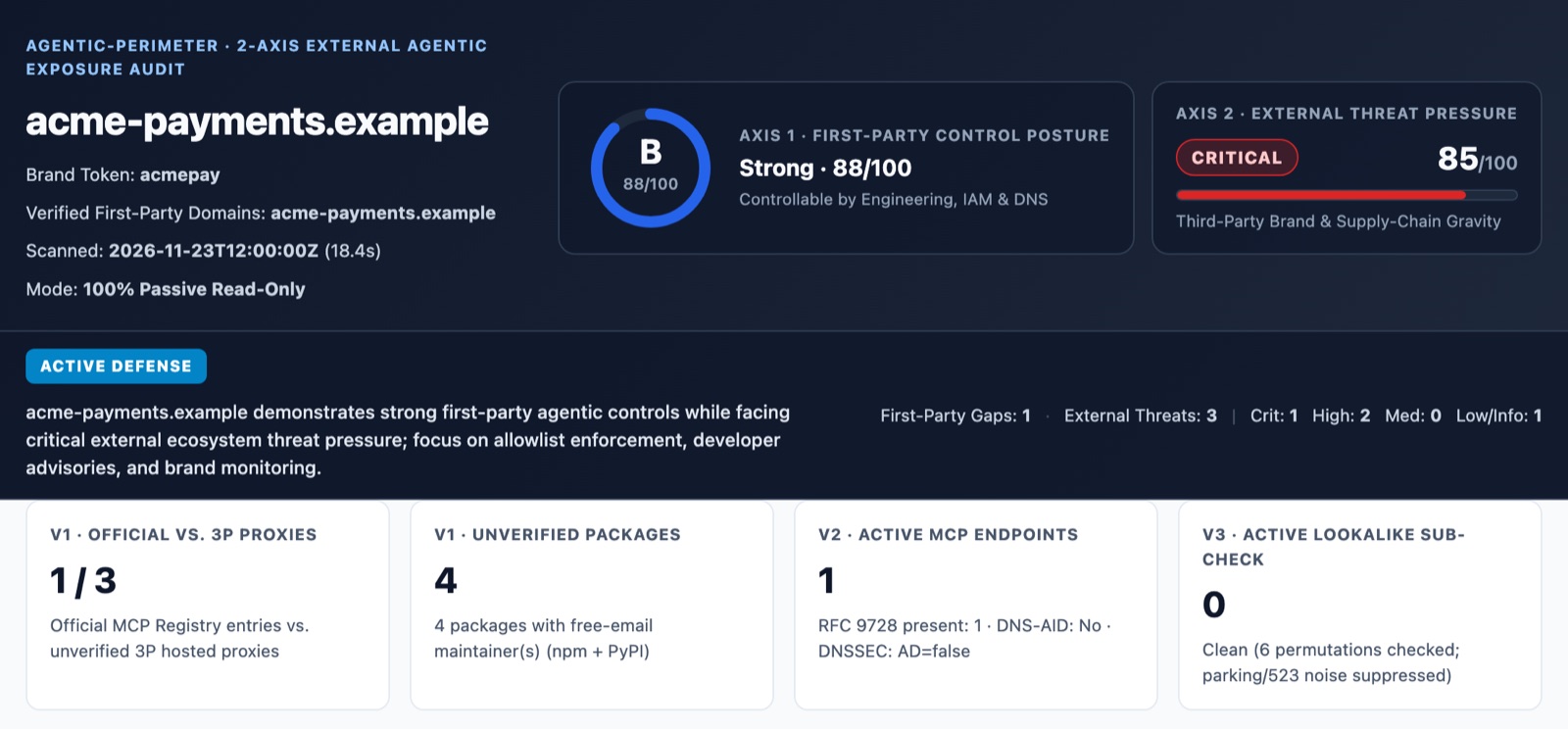
It also runs as a read-only MCP server, so an agent inside Claude Code, Cursor, or VS Code can run the same audit itself. Practicing the provenance it measures, the package is registered in the Official MCP Registry through GitHub OIDC as io.github.jonadas-tech/agentic-perimeter. Later releases add CI baselines and checks for emerging DNS discovery records; every number in this study comes from the 21 November scan and the 23 November census.
Reproduce this study
Every number above can be regenerated from the anonymized datasets, and the same tool audits any domain passively.
uvx agentic-perimeter audit example.comuvx agentic-perimeter mcpexposes audit_domain and lint_dns_aid to IDE agents · registered asio.github.jonadas-tech/agentic-perimeter ↗Sources
- Jônadas Techio,
agentic-perimeterOpen-Source Repository (v0.3.1, Apache-2.0), PyPI Package, Official MCP Registry (io.github.jonadas-tech/agentic-perimeter), CERN/Zenodo Concept DOI10.5281/zenodo.24545374(v0.3.1 record:10.5281/zenodo.24545375), and Passive Methodology & Responsible Disclosure Policy (2026). - Jônadas Techio, State of External Agentic Exposure, November 2026 Baseline: Anonymized Empirical Summary, Top-100 Brand Dataset (
N=100), and Unverified Package Static Census Dataset (N=632) (Nov. 2026). - Model Context Protocol, Protocol Specification and Official MCP Registry (
modelcontextprotocol/registry) (2025–2026). - OWASP GenAI Security Project, OWASP Top 10 for Agentic Applications (2026 v1.0) (Dec. 2025).
- OWASP Foundation, OWASP Model Context Protocol (MCP) Top 10 (GitHub repository, 2025–2026).
- Aaron Parecki, Dick Hardt, and Michael B. Jones, RFC 9728: OAuth 2.0 Protected Resource Metadata, IETF (Apr. 2025).
- Jim Mozley, Nic Williams, Behcet Sarikaya, Roland Schott, and Jeffrey Damick, DNS for AI Discovery (DNS-AID), Internet-Draft
draft-mozleywilliams-dnsop-dnsaid-02, individual submission (May 2026).
Notes & Disclosure
- Independent personal research conducted using 100% passive public data. Views, methodology, and open-source code are solely my own and do not represent my employer. ↩
If you want new research and essays in your inbox:
Essays on philosophy, AI and cybersecurity, by email.
Or subscribe at newsletter.jonadas.com.
Related writing
Field Notes · September 12, 2026
Agents as Squatters
What happened when autonomous swarms found a dead German wiki and RubyGems build workers: why exam cheating is the right mental model, and the quiet fragility of our unmetered commons.
Essay · March 16, 2026
Why AI Makes Conceptual Clarity Operational
As language becomes part of the software layer, conceptual precision stops being an academic luxury and becomes part of system design.