Part 3 in The Recognition War series
The Recognition War: The Raised Hand
Why people who think differently in private vote the same when everyone is watching.
In the first two parts of this series, we traced the engine of political hatred to thymos, the hunger for recognition measured on a fractal ladder (Part 1: The Ladder), and examined how status rivalry leads both camps to falsify each other's work and knowledge in mirror image (Part 2: The Refusal). This third part asks how private contempt becomes a group's mandatory common sense.
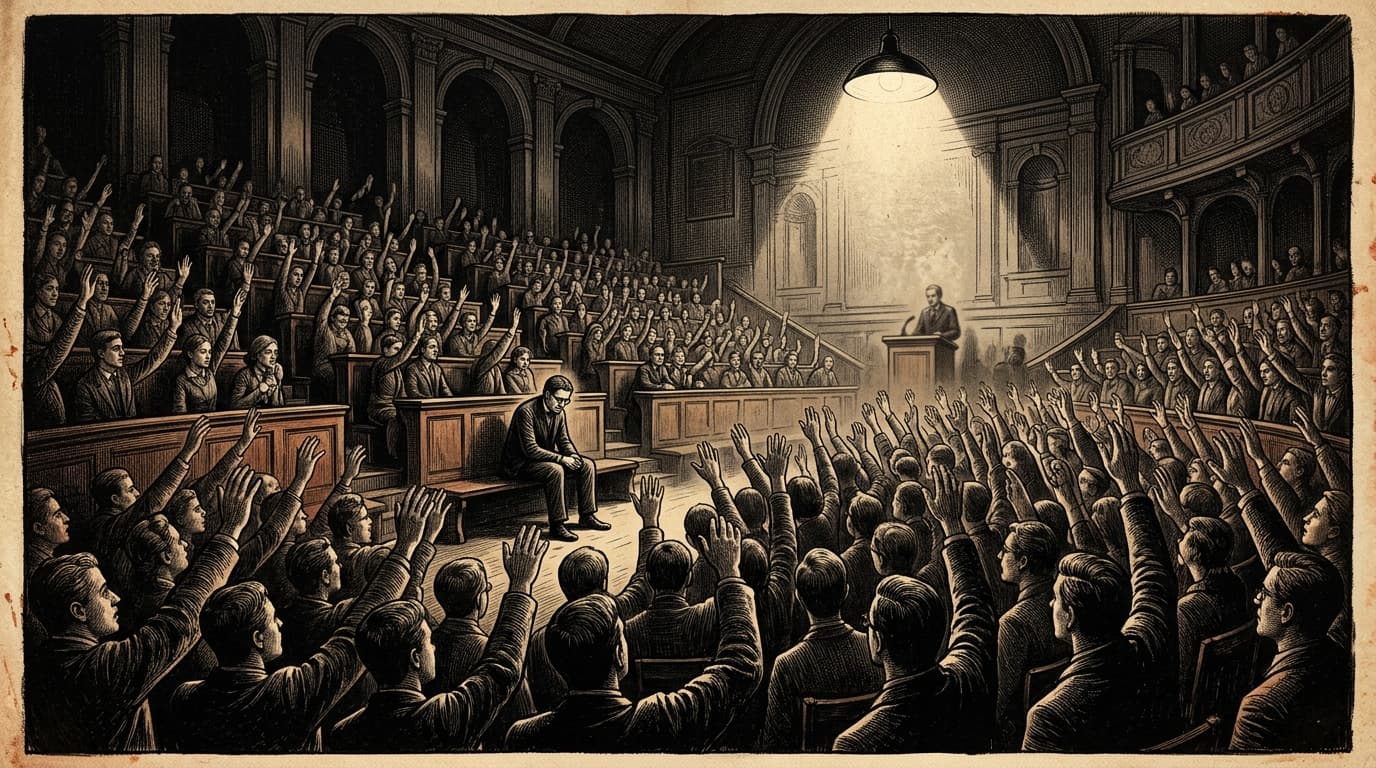
An auditorium at eleven
When I arrived at the public university to study philosophy, and later when I joined its faculty, I expected a republic of the better argument: a room where people sit down prepared to let reasons weigh more than rank. What I often found in student and faculty strike assemblies was something closer to a liturgy.
Long before smartphones entered our pockets, anyone who spent the 2000s and 2010s at a Brazilian public university learned the choreography of those nights. The auditorium holds four hundred people; on a strike night, six hundred pack the steps and stand along the back wall. Someone has propped open the fire doors to let in air, and the noise of the corridor drifts in with it. Behind a long table on the stage sit the organisers running the meeting: one holds the microphone, another keeps the list of speakers on a pad of paper, a third props up a phone as a timer.
Often the grievances that called the meeting were real enough: frozen research grants, crumbling campus buildings, salaries eroded by inflation. Yet watch how the room decides what to do about them.
The first two hours belong to the organised factions. Their speakers put their names down early, speak in the practiced cadence of people who have done this many times, and finish each three-minute turn to rhythmic chants from the front rows. The chants are short and percussive. You can join them without thinking, which is part of their function.
Around nine o'clock, an unaligned engineering student or a junior lecturer gets to the microphone to ask a practical question. If we suspend the semester indefinitely, what happens to the poorer students who depend on the subsidised university cafeteria for their one real meal a day? What happens to the graduating students whose internships will be cancelled if the calendar slips by four months? She is not against defending the university. She just wants to know.
There is no practical answer. There is a murmur, then a few whistles. The next speaker from an organised group opens at the microphone with a familiar inversion: "Some people here seem more worried about their private careers and bourgeois schedules than about the survival of public education." The front rows erupt in applause. The student who asked the question sits down. She does not go back to the list.
That move at the microphone is telling: rather than face a stubborn piece of reality (hungry classmates and cancelled internships), the speaker translated her concrete question into an ideological test ("bourgeois schedules" versus "the survival of public education") and invited the hall to boo. Once a practical difficulty is recast as a test of tribal loyalty, nobody in the room has to look at the cafeteria queue anymore.
Around ten, someone proposes that a decision affecting thirty thousand students and two thousand staff be taken by secret ballot, or by an online poll over forty-eight hours, so that evening students who work day jobs and live two hours away by bus can vote too. The table puts the procedural motion to the room. And the room votes, by raised hands, to keep the vote by raised hands.
By eleven, half the auditorium has gone home to catch the last buses. The people who remain are the ones who care most, or who have nowhere else to be, or who are afraid of what it would mean to be seen leaving.
Then the chair calls the vote. "Those in favour of the strike." Hundreds of arms go up, and people turn their heads across the rows to see whose hands are raised. "Those against." A small, exposed scattering of hands goes up, and every head swivels toward them. Nobody needs to write down names; everyone will remember tomorrow morning in the department corridor. "Approved by a large majority," the microphone announces. The room did not deliberate. It ratified.
More than once, sitting in the back rows of auditoriums like that, I kept my hand down and my mouth shut. Everyone in the building knew how many people had raised quiet doubts over coffee earlier that day about what an indefinite stoppage would do to working students and to the semester calendar; when the chair called the vote under the eyes of the hall, almost none of those doubts became a raised hand against. I sat there silent, not out of heroism, but with the contained anger of someone realising that trading the rural parish for the academic vanguard had only meant swapping one flock for another.
What made the auditorium work was not physical coercion. Not one person was threatened with a weapon or a fine. There was only the arithmetic of visibility. Raising your hand against cost something immediate: a reputation, a friendship, a quiet freeze in the corridor. Raising it in favour cost nothing and bought a little warmth. In an open vote, the question you are answering is never only "Should we strike?" It is also "Whose side are you on, in front of everyone?" And the second question is the one that governs the room.
Two ways to decide
Rooms like that are reported across Brazil every strike season. In November 2016, during a wave of campus protests against a federal spending cap, an open assembly of around two thousand students at the Federal University of Ceará voted in a "heated and indignant" hall for a student strike and the occupation of campus buildings, joining dozens of occupied campuses across the country.
During the April 2024 national faculty strike, however, a natural experiment unfolded across Brazil's federal universities. Most campuses voted the old way, in an auditorium, whereas a few separated public debate from a multi-day electronic ballot. Look at what happened to the size of the room and to the result.
At the Federal University of Minas Gerais (UFMG), a university with more than three thousand professors, the in-person assembly on 11 April 2024 approved the strike by 228 votes in favour to 140 against: just 368 ballots cast in total, barely a tenth of the faculty. A week later at the University of Brasília (UnB), another in-person assembly approved the strike by 257 votes to 213 (470 total).
Now compare what happened that same month where faculty unions held an in-person assembly to debate the motion, and then opened a private electronic vote over three to five days. At the Federal University of Santa Catarina (UFSC), turnout tripled to 1,118 professors, and the strike was rejected by 582 votes (52%) against to 512 (45.8%) in favour, with 24 blank ballots. At the Federal University of Goiás (UFG), 1,324 faculty members voted in the electronic plebiscite, splitting almost dead even: 657 in favour (49.6%) to 652 against (49.2%), a five-vote margin (Proifes), while at its two sister federal universities in the same state that also used electronic plebiscites that week, UFCat and UFJ rejected the strike by 61% and 57%.
The seven hundred extra voters at UFSC and UFG came from the silent majority: in an open-vote auditorium, a real fifty-fifty split in the community never looks like a fifty-fifty split on the floor, first of all because most of the people who oppose the motion never walk into the building. For the two hundred committed militants, a four-hour assembly is vocation and fellowship; they will be there from the first speech to the final chant. For the professor with a newborn at home, the researcher running a laboratory, or the lecturer who simply thinks a strike is a mistake, spending four hours in a stuffy hall to be whistled at and outvoted is a tax with no return. The open assembly decides the outcome before the first hand is raised, by filtering who can bear the cost of being in the room.
Norms at the front, lies at the back
What about the people who do show up? The oldest explanation for that night in the auditorium is also the most comforting. Since the late nineteenth century, popular crowd theory has pictured the crowd as a creature that dissolves individual reason: swept along by contagion, people lose their minds and become suggestible automatons. It is a satisfying story because it lets everyone in the building off the hook. The crowd did it.
Four decades of empirical crowd psychology show otherwise. People in crowds do not lose their identity or their capacity to reason; they shift from a personal identity to a shared social identity, policing themselves and others strictly according to the norms of the group.
Put the attendance filter together with what happens inside the hall, and you can see how a two-stage machine manufactures unanimity out of a divided community.
At the front of the auditorium, among the hundred and fifty militants chanting in unison, the shared-identity model holds: they have not lost their minds; they are enforcing a group identity whose core rule is militant solidarity.
In the back rows, among the minority of doubters who did come, a second mechanism takes over. Because two-thirds of their fellow sceptics stayed home, they look around and see a room overwhelmingly tilted toward the stage. In Private Truths, Public Lies (1995), the economist Timur Kuran names their response preference falsification: saying in public what you do not believe in private, or keeping your hand down, because the social cost of honesty is higher than the cost of the lie.
Each individual act of preference falsification is locally rational. Why pay the corridor tax alone for a vote you cannot flip by yourself? Yet add those private silences together and they produce a mirage that social psychologists call pluralistic ignorance: a state in which a large share of a community privately rejects a norm, but conforms to it because everyone looking at the room concludes that almost everyone else sincerely accepts it.
Stay inside a room like that long enough, and the falsification moves from your raised hand into your head. It becomes a hive conscience. Before we ask whether a claim is true or fair, we first work out whom the judgment will align us with. The moral question ("Is this right?") gets quietly replaced by a social one ("Where will this put me?"). That is thymos doing reason's job: not that we stop thinking, but that we think after we have checked where we stand.
Kierkegaard said it with less data and more heat a century and a half ago: "the crowd is untruth." Not because crowds are stupid, but because in a crowd nobody has to answer alone for what the room just did.
The assembly that never adjourns
Now step out of the auditorium and pick up your phone. The same two filters that empty and silence the university hall govern our national political war: the feed functions as a permanent open-vote assembly.
Every political post is a motion put to the floor. Every like is a hand raised and counted in public. Every share is a hand raised a second time, louder. And every silence is noticed: the friend who didn't repost the morning's outrage, the colleague who didn't sign the open letter, the cousin who didn't react.
The auditorium at least ended. At midnight the janitor switched off the lights and people went home. The feed never closes the session, never offers a secret ballot, and keeps a searchable record of how you voted years later. Worse, it collapses all your separate rooms (your family, your department, your employer, your clients, and strangers who will never meet you) into a single bleachers section watching your hand.
Think back to the morning after the vote in Part 1, the thumb on the glass. What I was watching was hundreds of thousands of assemblies at once, each one counting hands.
That architecture explains why one of the most popular remedies for online polarisation, "bursting the echo chamber" by showing people posts from the other side, so often backfires. In 2018, the sociologist Christopher Bail and colleagues paid Democratic and Republican Twitter users in the United States to follow a bot that retweeted messages from the opposing camp for a month (Bail et al., 2018). Republicans exposed to Democratic voices became substantially more conservative afterwards, and Democrats shifted slightly further left. Exposure to the other side inside an open arena is not human contact; it is watching the rival team raise their hands and chant on stage. It confirms what you already suspected: they really are like that.
What the evidence says
It is tempting, at this point, to blame the machine for everything. In his conversation with Ezra Klein, Fukuyama comes close to this, arguing that social media is far more important than other explanations for the rise of populism because only technology explains why so many countries polarised at the same time.
As someone who works in technology and builds software systems, I have to disagree with him here, so as not to turn "the algorithm" into a convenient scapegoat. Blaming the code lets human beings off the hook just as surely as nineteenth-century crowd theory did. And the strongest causal experiments of the past decade ask for more caution.
| Study | What they did | What they found |
|---|---|---|
| 1. Switching off the feed or the ranking algorithm barely changes dislike | ||
| Boxell, Gentzkow & Shapiro (2017) | Compared polarisation across US age groups over twenty years | Polarisation grew fastest among the over-65s, the demographic least online. |
| Allcott et al. (2020) | Paid US users to deactivate Facebook for 4 weeks before the 2018 midterms | Polarisation on policy issues fell modestly; how much people disliked the other party barely moved. |
| Guess et al. (2023) | Switched Facebook and Instagram users to a chronological feed for 3 months in 2020 | Users spent less time on the platforms, with zero measurable change in dislike of the other side. |
| Allcott et al. (2024) | Deactivated Facebook or Instagram for ~35,000 users for 6 weeks before the 2020 election | Effects on affective polarisation and political beliefs were close to zero. |
| 2. Inside the feed, the scoreboard rewards attacking the other side | ||
| Brady et al. (2021) | Tracked moral outrage among 7,331 Twitter users | Likes and shares for outrage trained users to express more of it on following days. |
| Rathje et al. (2021) | Analysed ~2.7 million posts by US news outlets and politicians | Posts attacking the opposing camp were shared at roughly double the rate of posts praising one's own. |
Switching the apps off for a few weeks, or stripping out the ranking algorithm, barely changes how much we dislike the other side. What the feed actually does is simpler and more insidious: it pays for contempt.
Anyone who posts online has felt this reinforcement loop. You write a sober paragraph about a public problem: silence. The next day, you write a sentence half a tone sharper than usual about the rival tribe. Within minutes, the counter starts turning. Notifications arrive from people who think like you, bringing a warm rush of belonging. The next morning, without any engineer pulling strings, your sentence comes out a full tone crueller. The machine does not create thymos: it prices it, and it trains it.
Electricity in the family circuit
In Brazil, much of political opinion is formed not in open feeds like X or Instagram, but in closed WhatsApp groups: the extended family group, the church group, the group of old school friends.
No recommendation algorithm ranks what you see there. Something older and stronger does: personal endorsement inside networks of primary trust. The alarming audio clip or the video ridiculing the enemy does not arrive from a bot; it arrives from the aunt who baked your birthday cake, or the uncle who helped your father roof the house.
I know the silence of that digital room as well as I know the silence of the university auditorium. Whenever an election approaches and someone in a southern family chat forwards an alarming clip warning that small workshops and rural properties are about to be confiscated or taxed into ruin, followed within minutes by flags and amens, I find myself staring at the glass with my thumb over the keyboard. Typing a factual correction in that window is never read as a note about tax law. It is read as the professor nephew coming back from the capital to lecture the family. So you lock the phone and say nothing.
Here the psychiatrist Murray Bowen, who founded family systems therapy, sees something that media studies miss. Bowen thought of a family not as a collection of separate individuals, but as an emotional circuit in which chronic anxiety moves from person to person, like electricity through a wire, until someone absorbs or discharges it.
Bowen also distinguished two parts of the self. The solid self is made of convictions you have examined and can stand behind: the part that can say "I think" and mean it even when the room disagrees. The pseudo-self is borrowed from the group and constantly renegotiated to keep the peace. And what Bowen calls functional differentiation varies by room: the very same person can act with a solid, independent self when running a metal workshop or writing code on Friday afternoon, and collapse into a compliant pseudo-self at the faculty assembly on Friday night or the family WhatsApp group on Sunday morning.
A family group in election season is an anxious circuit with a live microphone. When your aunt forwards the partisan clip, she is rarely making an argument about public policy; her pseudo-self is sending a signal of belonging: I am still one of you. And when cousins stay silent in the chat, or when colleagues stay silent in a faculty WhatsApp group while peers caricature half the electorate, they are practising the exact same preference falsification I practised in the back row of the auditorium.
The sacrifice that stopped working
Put the ladder of Part 1 together with the permanent visibility of Part 3, and Girard's darkest discovery takes on a new form.
In The Scapegoat (1982), Girard showed how archaic communities caught in a fever of rivalry discharged the tension by converging on a single vulnerable victim: all against one. The collective lynching brought a sudden, miraculous peace among the lynchers. Looking around at their shared relief, they felt like brothers again.
Social media industrialised the ritual. Every morning both political trenches wake up hungry for a "main character of the day" (a clumsy shopkeeper, a caricatured activist, a professor quoted out of context) whose public execution before lunch lets hundreds of thousands of spectators share a surge of moral superiority without lifting a finger in the physical world.
Yet something fundamental has broken in the ritual: the sacrifice has stopped working.
Girard argued that modern culture has been permanently unsettled by the exposure of the victim's innocence: we can no longer lynch with a clean conscience. Our digital architecture adds a second, structural reason why the sacrifice fails. In the old village, the lynching brought peace because the crowd was unanimous and nobody stood outside the circle to defend the victim. In a digital arena split fifty-fifty into two giant assemblies, there is no unanimity. Every victim destroyed by one tribe before noon is carried across the trench by the other tribe and crowned a martyr by dinner. Humiliate a pastor in a viral progressive clip and you supply six months of conservative mobilisation. Mock a scientist or a schoolteacher and you fuel the progressive trench in equal measure. The sacrifice no longer pacifies the city: it keeps the feud going.
The quiet majority and the back row
What happens to everyone who does not want to join the lynching party?
In a recent conversation, my friend and fellow philosopher Flavio Williges raised an objection that the street confirms the moment you put your phone in your pocket: this deafening duet of tribal resentments is not Brazil. Most people are simply tired.
Because the loudest partisans at the front of the room attack anyone who hesitates, ordinary moderates quickly conclude that speaking up online brings all punishment and no reward. So they retreat to the back rows and go quiet. Once they go quiet, the visible arena is left entirely to the most aggressive voices on both flanks, making each camp look twice as fanatical as it really is.
Two sets of numbers from Brazil's 2026 election show how wide that distortion has grown.
First, look at the ballot box. In the first round on 4 October 2026, 21.08% of eligible voters (over 33 million citizens) did not vote, leaving the silent share near historic highs (G1; Poder360). Add blank and null ballots and votes for other candidates, and nearly one in three Brazilian adults gave their vote to neither finalist.
Forced into a binary choice three weeks later on 25 October, the silent share shrank at the edges: 2.96 million more voters turned out, bringing abstention down to 19.22% (30.51 million citizens), while blank and null ballots dropped by 1.82 million to 3.24% (G1). Even so, under the fiercest campaign pressure in recent memory, 34.66 million eligible Brazilians (21.8% of the electorate, more than one in five adults) still chose neither finalist, and the winner was elected by roughly 40.5% of all eligible adults (TSE). Even among those who did vote for one of the two names, a vast share were voting against the side they feared rather than cheering for the side they chose.
Second, look at what voters actually believe in private, and who misreads them most badly. In August 2026, More in Common Brasil and Ipsos-Ipec gave voters of Lula and of Flávio Bolsonaro six statements about values and social policy. Each person rated their own agreement from 0 to 100, and then guessed how the other side would rate the same sentence.
Look at that highlighted third row in the top panel. Bolsonaro voters gave 86 out of 100 to "it is good that poorer people can travel by plane", and 94 to equal pay for men and women. Lula voters gave 95 to "the family is the foundation of everything", and 84 to not depending on government handouts. Across all six statements, real agreement never fell below 70 in either camp.
Yet each side imagined the other roughly twenty points lower. And the most unsettling finding: the distortion nearly doubles among voters with a university degree. Lula voters with a degree guessed that Bolsonaro voters would give 59 to poorer people flying, a 27-point error that matches the 2019 American Perception Gap study. As Pablo Ortellado, who led the Brazilian study, observed, the gap "is not a wrong estimate caused by ignorance or lack of schooling." Read through the argument of this essay, that is what the hive conscience looks like in data: the educated have more sophisticated abstractions with which to classify the other side, live in more homogeneous rooms, and often have more to lose in their professional assembly if they are caught being charitable to the wrong tribe.
Before we celebrate the quiet majority who stay out of the fight, however, we need to look in the mirror one more time. Because the back row has its own vanity.
I told myself at the time that my silence in those auditoriums was prudence, or maturity, or a refusal to play a rigged game. Some of it was. But some of it was simply that I wanted to keep my standing with both sides of the room: to stay one of the reasonable ones, unstained by either the chant or the dissent. In Bowen's terms, walking out of the room or muting the family chat is not differentiation at all; it is emotional cutoff, managing anxiety by severing contact while congratulating yourself on being above the fray. Standing apart from the crowd to keep clean hands is not the same as having a solid self. It is just thymos in its quietest, most academic disguise.
Which leaves the hardest question for the final part.
If the caricatures we hold of our neighbours are not caused by a lack of schooling or data (since the data are public and the educated get the neighbour most wrong), and not caused by the machine alone (since switching it off barely helps), then what is going on inside each of us? Not a lack of information: something we do with what we already know.
Next in the series · Part 4 of 4
What Weighs. A nun in a psychiatric ward, Stanley Cavell's distinction between knowing our neighbours and acknowledging them, Cora Diamond on the "difficulty of reality" and realism, Murray Bowen's electrical insulator, and what the grain of a wooden board and the blacksmith's forge teach about resisting the crowd.
References · Part 3
- Public assembly & plebiscite records: UFC student assembly, Nov 2016 (Esquerda Online); campus occupations, Oct 2016 (Agência Brasil); UFMG in-person strike assembly, Apr 2024 (Estado de Minas); UnB in-person strike assembly, Apr 2024 (G1); UFSC electronic strike vote, Apr 2024 (Apufsc); UFG electronic plebiscite, Apr 2024 (Jornal Hora Extra), UFG, UFCat & UFJ plebiscites, May 2024 (Jornal Opção), and Proifes.
- Crowd psychology: Le Bon, G. The Crowd (1895). Reicher, S. "The Psychology of Crowd Dynamics", in Blackwell Handbook of Social Psychology: Group Processes (2001). Stott, C. & Drury, J. (Oxford Research Encyclopedia of Criminology, 2017).
- Kuran, T. Private Truths, Public Lies: The Social Consequences of Preference Falsification (Harvard UP, 1995).
- Prentice, D. A. & Miller, D. T. "Pluralistic Ignorance and Alcohol Use on Campus." Journal of Personality and Social Psychology 64(2), 1993, pp. 243-256 (doi).
- Burgis, L. Big Think interview, 23 Oct 2026 (video). Robbins, H. "The One and the Ninety-Nine [review]", Substack, 20 June 2026.
- Social media & polarisation studies: Boxell, L., Gentzkow, M. & Shapiro, J. M., PNAS 114(40), 2017 (doi); Bail, C. A. et al., PNAS 115(37), 2018 (link); Allcott, H. et al., American Economic Review 110(3), 2020 (doi); Brady, W. J. et al., Science Advances 7(33), 2021 (doi); Rathje, S. et al., PNAS 118(26), 2021 (doi); Bail, C. Breaking the Social Media Prism (Princeton UP, 2021); Guess, A. M. et al., Science 381, 2023 (doi); Allcott, H. et al., PNAS 121(21), 2024 (link); Odgers, C., Nature 628, 2024 (link); Bak-Coleman, J. B., Nature Reviews Psychology 4(9), 2025, p. 615 (doi).
- Bowen, M. Family Therapy in Clinical Practice (Jason Aronson, 1978). Girard, R. Violence and the Sacred (1972); Things Hidden Since the Foundation of the World (1978); The Scapegoat (1982).
- More in Common Brasil / Ipsos-Ipec, "Descompasso de Percepção", Aug 2026. More in Common US, The Perception Gap (2019). Samuels, D. J. & Zucco, C. Partisans, Antipartisans, and Nonpartisans: Voting Behavior in Brazil (Cambridge UP, 2018). First-round and run-off 2026 abstention data: G1 (1st round); G1 (run-off comparison); TSE.
If you want essays like this in your inbox:
Essays on philosophy, AI and cybersecurity, by email.
Or subscribe at newsletter.jonadas.com.
Related essays