Part 4 in The Recognition War series
The Recognition War: What Weighs
The difference between knowing your neighbour and acknowledging them.
The first three parts of this series examined how our hunger to be seen drives political rivalry up and down a status ladder (Part 1: The Ladder), how both camps falsify each other's values in mirror image while citizens reject the humiliation of paternalism (Part 2: The Refusal), and how open rooms and permanent digital feeds manufacture an artificial consensus (Part 3: The Raised Hand). This final part asks what is left to each of us once we stop blaming "ignorance" and "the algorithm".
The nun
In the early 1960s, at seventeen, the Australian philosopher Raimond Gaita took a summer job as an attendant in a psychiatric ward.
He tells the story in A Common Humanity (2000). The ward held patients considered incurable. Many had been locked there for decades, some for more than thirty years, long since abandoned by their families and friends. They had lost almost everything that ordinary social life relies on to grant a person standing in the eyes of others: coherent speech, memory, dignity of posture, even control of their own bodies.
When the patients soiled themselves, they were taken to the yard and washed down from a distance with hoses and long-handled brushes. Gaita does not describe the attendants as monsters. They were tired, underpaid workers doing a job no one else wanted, in an institution designed for storage rather than care.
There was also a small circle of young, reforming psychiatrists who fought hard to improve the hospital. In staff meetings and public lectures, they spoke earnestly of the patients' "inalienable human dignity". Gaita admired them deeply, and he was right to. They knew the clinical facts, held the right moral principles, and were doing more than anyone else.
Then one afternoon a nun came to visit the ward.
Nothing about her arrival stood out, until she walked up to the patients and began to talk with them. The way she bent down to listen, the unhurried warmth of her voice, the steadiness of her gaze, the complete absence of any bodily recoil or defensiveness: all of it produced a sudden, silent contrast in the room. Watching her, Gaita realised something that stayed with him for the rest of his life. The nun's way of being with those men showed that the reforming psychiatrists were, "despite their best efforts, condescending, as I too had been." Her posture revealed what it actually looked like to treat those patients as full human equals, and in doing so, it exposed that the doctors and attendants, for all their sincere professions of dignity, "had not, in our hearts, believed it."
The psychiatrists were not hypocrites. They meant every word. They had all the right information, all the right principles, all the right speeches. And yet something in the way they stood in that room said: these people are not quite like us. What they lacked was not one more fact in the file.
To name what the nun had and the psychiatrists lacked, Gaita turned to a sentence by the philosopher Iris Murdoch: "Love is the extremely difficult realisation that something other than oneself is real."
Not ignorance: avoidance
During my doctoral years studying the American philosopher Stanley Cavell, I found the exact distinction I have been working toward through this whole series.
In his essay "Knowing and Acknowledging" (1969) and later in The Claim of Reason (1979), Cavell took on one of modern philosophy's oldest puzzles: the problem of other minds. How can I know with certainty that you are genuinely in pain, that you have an inner life like mine, that there is someone in there at all? Philosophers had treated this as a problem of evidence, as if our distance from one another came from not being able to peer inside our neighbour's skull.
Cavell argued that the sceptic has the diagnosis backwards. Most of the time, we know enough. When I see you wince, I know you are hurt. When I watch a neighbour work fourteen hours to keep a small shop open, or read a survey showing that 86% of opposing voters think it is good for the poor to fly, I do not suffer from a deficit of data. The failure, when it happens, is a failure to acknowledge what I already know: to let your pain, your effort, and your reality make a claim on how I treat you.
And for Cavell, this failure is not passive. It is not a gap in schooling. It is something we actively do. In The Claim of Reason (1979, p. 389), he writes that "the alternative to my acknowledgment of the other is not my ignorance of him but my avoidance of him, call it my denial of him."
The opposite of acknowledgment is not ignorance. It is avoidance.
We arrange our concepts, our jokes, and our rooms so that we do not have to see what would oblige us to drop our condescension.
Think back to the More in Common data in Part 3. The survey numbers are public. Nothing in them is hidden. Yet the citizens most likely to read such surveys, the ones with university degrees, were the ones who misjudged the other side by twenty-seven points. We can memorise the agricultural census, quote the papers on platform work, recite the statistics on evangelical churches in the urban periphery, and still fail exactly where Gaita's psychiatrists failed: speaking about the country from the hygienic distance of a hose.
Cavell borrowed a word from Ludwig Wittgenstein to name the extreme form of this refusal: soul-blindness. To look at a human face and see only a sociological specimen: a "colono", a "fascist agro-predator", an "alienated believer", an "indoctrinating parasite", a "bolsominion", a "petralha".
Recognition that counts, recognition that weighs
Now I can say what I think has gone wrong with the politics of recognition itself.
Writing this series in English forced me to notice a distinction hidden inside my native language. Where Portuguese has a single word, reconhecimento, English separates recognition from acknowledgment. The difference is the difference between two movements of the soul that point in opposite directions.
The first is recognition that counts. It is the territory of thymos as we met it in Part 1 and Part 3: the struggle to be seen, the measurement of standing on the ladder, the live counter under the post, the raised hand in the auditorium. It is comparative and scarce. On a scoreboard, isothymia (the just demand not to be humiliated) is always in danger of being swallowed by megalothymia, because the fastest way to make your number go up is to make someone else's go down.
The second is recognition that weighs. That is Cavell's acknowledgment. It is not a new piece of information about the other, and it is not a medal awarded from the height of a podium. It is letting what I already know about the other's pain, labour and humanity put real weight on what I say and do.
The nun did not give the patients in that ward a higher score. She did not out-argue the psychiatrists. She let what everyone in the room already knew, that these men were human beings, weigh on the way she bent down to listen.
Fusion as a way of not looking
Why is acknowledgment so rare among intelligent, decent people when the facts about their neighbours are right in front of them? Because Murray Bowen's fusion and Stanley Cavell's avoidance are two halves of a single lock.
In Part 3 we saw how an anxious group pushes its members toward fusion: you think with the group, feel with the group, and lend your eyes to a collective pseudo-self. And above, we saw Cavell's insight that we avoid acknowledging our neighbour because letting his reality weigh on us would oblige us to change how we stand.
Put those two mechanisms together and something clicks: we fuse with our own tribe in order to outsource the avoidance of our neighbour.
When I stand in front of my neighbour alone, across a fence or a shop counter, avoiding his humanity takes work. I can see the calluses on his hands, the tiredness in his eyes, the decency of his effort. Once my judgment is fused with my group's hive conscience, however, I no longer have to look at him at all. The group has already issued the verdict. The professor who mocks the "fascist" small farmer has read the farm census; the farmer who forwards a meme calling university scientists "parasites" plants seeds developed in public agronomy labs and vaccinates his grandchildren. Neither is short of facts. Both have outsourced their seeing to the room, because letting what they already know weigh on them would cost them their place at the table. Fusion is not a failure to know: it is a way of not having to look.
The philosopher Cora Diamond gives us the exact name for how educated people pull this off in good conscience. In her essay "The Difficulty of Reality and the Difficulty of Philosophy" (2003), building on Cavell, she describes what happens when we come face to face with a reality that resists our tidy moral categories and makes a claim we do not want to bear. She calls that resistant weight the difficulty of reality: moments when something in the world is too awkward, too wounded, or too stubbornly human to fit inside the story our room tells about itself.
How do articulate people protect themselves from that exposure? Through what Diamond calls deflection: we trade a lived difficulty of reality for a manageable theoretical or ideological debate. Remember the speaker in the university assembly in Part 3 who answered a classmate's question about hungry cafeteria students by accusing her of worrying about "bourgeois schedules". Remember the sociological labels in Part 2 that turn the family farmer into "fascist agro", the courier into the "uberised precariat", and the public-school teacher into a "parasite". Each of those labels is a machine for deflection. It replaces a flesh-and-blood neighbour whose life would unsettle our tribe's script with a paper token on a blackboard. The payoff is immediate: once the neighbour has been turned into a thesis, we no longer have to acknowledge him; we only have to refute him.
Realism, the insulator, and the grain of the wood
So the way out must involve what Bowen called differentiation: a solid self that holds its own convictions while staying in contact with others. Not fused with the group, and not cut off from it either.
Yet here we run into a double trap. First, as Girard warned in Part 1, rivals who define themselves against each other become doubles. If I try to differentiate myself against my tribe, or against the other tribe, I just become a contrarian double. The person who prides himself on seeing through the herd (the person I was in those back rows) is still playing for the scoreboard; he just wants a niche score. Second, in matters of social contagion, the sick cannot write their own prescription. You do not get a solid self by looking in a mirror and deciding to be authentic.
So it cannot be differentiation against. It has to be differentiation toward: toward something outside the mirror that resists both camps, and that neither camp can turn into a double. A task, a material, a person in front of you.
In The Realistic Spirit (1991), Diamond draws on a remark of Wittgenstein's ("Not empiricism and yet realism in philosophy, that is the hardest thing") to give a quiet name to that posture: realism. Not realism as a philosophical doctrine, and not the cynical "realism" of politicians who say only power matters, but the hard discipline of looking at what is in front of you without letting a prior requirement dictate what must be there. Where deflection retreats from the difficulty of reality into a tribal script, realism stays with the friction of what is not you.
I learned that kind of realism, as far as I have learned it, with my hands.
Before university, and alongside it, I took whatever manual work paid my bills, from carpentry and house painting to waiting tables, and spent weekends during my degree crimping network cables and compiling the Linux kernel in a terminal window before sitting down on Monday morning to discuss Kant or Wittgenstein. Listing old jobs can easily become its own reverse snobbery, just another way of gaming the ladder. What mattered in those jobs was not the credential of calluses; it was the stubbornness of the material.
Anyone who has pushed a hand plane over a rough board knows a truth no manifesto can repeal: the physical world does not bend to slogans. Plane against the grain and the iron catches, the fibre tears, the piece is lost. The computer terminal taught the exact same ethic in silicon: one misplaced character in a configuration file and the machine returned a kernel panic and refused to boot, wholly indifferent to the political intentions of its operator.
The grain of the wood is not on anyone's side. You cannot out-rival a board, and you cannot intimidate a compiler by raising your hand in an auditorium. You can only attend to it.
That daily apprenticeship with things that do not lie became my anchor when university life drifted into high-altitude abstraction. In seminar rooms I heard colleagues speak fluently about "Capital", "bourgeois exploitation" and "the agrarian question", and it was hard not to notice that almost none of them had ever issued an invoice, held a heavy tool for eight hours, or looked at the sky in terror that an unseasonal frost would wipe out a family's whole year.
When I thought of my parents getting up in the dark to light the restaurant stove; of my mother's brothers, who started out hammering iron at my grandfather's forge and spent decades building a factory of window frames and truck bodies; of my father's brothers, who came out of the choking dust of the basalt quarries and a modest brickworks to build a stone-cutting business and a trucking company, the seminar label "exploiting bourgeoisie" sounded like a bad joke. No one who knows the heat of the anvil, the dust of crushed gravel, and the Friday-afternoon anguish of meeting a small payroll can look at those people and see a class enemy.
Literate contempt for productive work rarely arises in front of real people. It arises when thought gets used to living among deflections on a blackboard, where "Capital" is always an idle speculator. The trouble starts when the rhetoric comes down from the blackboard to the ground of culture and tax law: the accusation designed to hit the top slides down and hits whoever is climbing the ladder.
Once your hands and eyes are anchored in realities that resist tribal scripts, you can step back into Bowen's electrical circuit and play a specific role: neither a conductor nor a runaway, but an insulator.
An insulator does not cut the wire. Cutting the wire is emotional cutoff: walking out of the Sunday lunch, blocking the uncle, retreating into a gated enclave where everyone shares your diploma and your vote. The insulator stays wired into the circuit on both sides, remaining in real contact with the university colleague and the small-town relative, but refuses to conduct the voltage of contempt.
When someone at an academic café makes a knowing joke about the "ignorant interior" or the "fanatical evangelical", acting as an insulator does not require a sermon; it means refusing the complicit laugh and reminding the table of the crop loan signed against the family land, the terror of a dry January, the Friday-afternoon scramble to meet a workshop payroll, and the parish hall that kept a neighbourhood's teenagers alive. And when someone at a business dinner or a Sunday barbecue repeats a sneer about "parasite professors" or "rigged science", it means refusing the easy nod and reminding the table that the soy seed in the silo, the encryption protecting the bank transfer, and the vaccine in the grandchild's arm were built by people who spent their lives on questions that do not pay out on a Friday balance sheet.
A truce of decency
None of this scales by decree. No law can manufacture the nun's way of bending down. Acknowledgment is first-person work. Even so, institutions can stop pouring petrol on the circuit, and establish what we might call, after Margalit, a truce of decency.
How far our political leadership remains from that truce was plain on both microphones on the night of the run-off, 25 October 2026. In Brasília, hours after the electoral court finished counting the 128.2 million ballots, Senator Flávio Bolsonaro stood outside his campaign headquarters without taking questions or mentioning the 59.8 million citizens who had voted for him, and used the very word at the centre of this series: "It is impossible to recognise the result of the elections in the context in which these things happened," he declared, promising that his lawyers would seek to annul the vote after Supreme Court Justice Cristiano Zanin extended polling hours by two hours from 5:00 PM to 7:00 PM in several logistical transport bottlenecks, acting on formal requests submitted by both campaigns (Agência Brasil; BBC News Brasil). In São Paulo, meanwhile, Lula thanked the voters who had delivered his historic comeback, including elderly and ill citizens who had come to the polls, and promised dialogue with Congress and greater popular participation (Agência Brasil). Yet when he spoke at the InterContinental Hotel and then stepped onto the stage on Avenida Paulista beside federal deputy André Janones, coordinator of the campaign's Exército do Lula WhatsApp channel, the language of the permanent assembly took over. Denouncing foreign digital platforms and warning that he would no longer allow himself "to be interpreted by bad-faith journalists", Lula turned to Janones before the crowd and gave him a marching order: "We won the first battle. The army cannot disperse. The army will have to continue" (Agência Brasil; Poder360).
I will not invent an institutional equivalence where there is none; contesting the ballot count wounds the rules of the republic, while maintaining a digital army wounds its civic fabric. One podium refused to recognise the neighbour's vote; the other announced that its WhatsApp army would never demobilise.
If the podiums will not disarm the war of recognition for us, the truce has to be built closer to the ground, across four practical habits.
Stop humiliating. Margalit's test from Part 2 cuts both ways, and every government can be held to it. A labour law that offers protection to app workers without demanding union tutelage; a tax system that does not treat every small-business owner as a cheat while writing tailor-made breaks for Brasília lobbyists; a police stop that does not treat the young Black man from the outskirts as a presumed criminal; and a presidency that never again calls universities a "racket" or throws health-agency scientists to digital mobs: that is the minimum institutional truce between productive work and knowledge.
Correct the picture, again and again. In 2024, a megastudy in Science led by Jan Voelkel and Robb Willer, across more than 32,000 participants, tested 25 interventions to reduce partisan animosity in the United States (Voelkel et al., 2024). Twenty-three worked in the short term, and some of the best simply corrected inflated beliefs about what the other side actually thought. Yet the effects were modest, and most faded within two weeks. Correcting the caricature is not a vaccine: it is daily hygiene, something you practise every week or lose.
Give people a secret ballot after open debate. The universities in Part 3 that let members vote privately over two days, after debating in public, were not suppressing deliberation. They were lowering the artificial price of honesty. A community that only ever decides with hands in the air will never find out what its members actually think.
Anchor civic life in shared physical work. Hostility between rival groups rarely recedes through lectures on tolerance or staged dialogues about identity; it recedes when equals work side by side on a concrete task that needs both. That is the hand plane applied to a neighbourhood. We saw it across Rio Grande do Sul during the catastrophic floods of May 2024, when the Guaíba rose into the streets of Porto Alegre and cut off entire municipalities across the valley. At the boat ramps improvised on flooded avenues and in the shelters set up inside parish halls and university gymnasiums, pickup owners hauling aluminium skiffs, military police officers, federal university volunteers, and evangelical church kitchens worked the same muddy water for weeks. Nobody in a rescue boat asked how a family had voted before pulling them off a roof. The water was real, and its weight silenced the scoreboard in an instant. For a few weeks, the difficulty of reality broke the spell of deflection.
The forge
I promised in Part 1 that the first suspect in this story would be me. Let me keep that promise before I close.
Looking back across the rungs I have climbed, I know three avoidances from the inside.
As the boy from the village seduced by the prestige of books, I looked with impatience at the farmers and shopkeepers around me, avoiding what my quiet hours of reading owed to the calloused hands that kept that ground standing.
Years later, settled inside the public university and repeating its critical vocabulary against the abstractions of "Capital", I avoided saying aloud, more than once, that my uncles' window-frame factory, my family's basalt quarry, and my parents' highway restaurant demanded a daily courage and a practical honesty that no academic assembly could teach.
And later still, working inside the speed of the global technology industry, I met the temptation of a third avoidance: to look with executive impatience at slow philosophical hesitation, at basic science without an immediate market, and at the fragile institutional guardrails that keep power honest, as if they were unproductive luxuries.
Each rung of the ladder handed me a polished vocabulary tailored to deflect the difficulty of reality of the people on the other rungs. On not one of those three floors did I lack information about who was below or above me.
When I want to remember what realism looks like when it refuses to look away, I do not think of a seminar room. I think of my maternal grandfather's forge, where my mother's brothers learned to work iron before they built their factory.
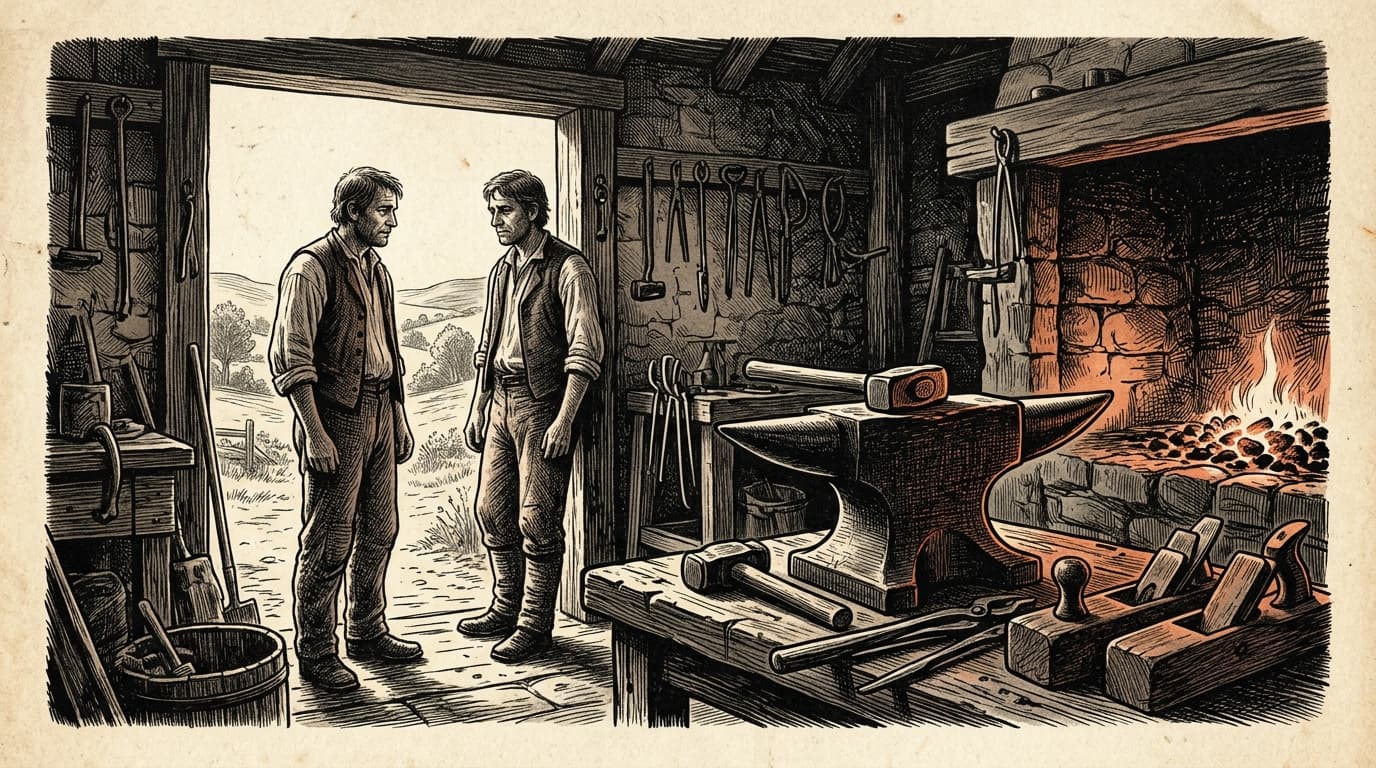
The shed was dark even at noon, thick with coal smoke and the sharp hiss of steam whenever hot steel went into the water trough. What stayed with me from watching them work a bar of iron between the fire and the anvil was the silence of their attention. You cannot rush the coal, and you cannot strike while the metal is still dark or after it has cooled to grey. You watch the colour of the iron in the embers until it reaches the exact heat, set it square on the face of the anvil, and bring the hammer down without a word of performance, because the iron will not yield to a speech.
I think of the three hands in this series. The hands raised at eleven at night in the crowded auditorium, turning heads across the rows. The thumb on the smartphone glass on the morning after the election, counting who was up and who was down. And the hands at the forge, which were not raised to be seen by anyone, and were not counting anything. They were attending to the iron, because the iron would not lie to them, and neither, in that moment, could they.
Thymos will not go away. We will always need our lives and our labour to be seen. The question this series leaves is not how to stop wanting recognition. It is which kind we let govern us: the kind that counts, where my standing needs your fall, or the kind that weighs, where what I already know about you is allowed to change what I do.
The election is over. The official counter has stopped, even if neither podium quite let it go. Tomorrow morning, before I wash my face, my thumb will reach for the glass again, and so, probably, will yours.
The scoreboard will be there. So will the neighbour.
References · Part 4
- Gaita, R. A Common Humanity: Thinking About Love and Truth and Justice (Routledge, 2000), pp. 17-20; Romulus, My Father (1998).
- Murdoch, I. "The Sublime and the Good." Chicago Review 13(3), Autumn 1959, p. 51 (quoted in Gaita, 2000).
- Cavell, S. "Knowing and Acknowledging", in Must We Mean What We Say? (Cambridge UP, 1969), pp. 238-266; The Claim of Reason: Wittgenstein, Skepticism, Morality, and Tragedy (Oxford UP, 1979), Part IV, p. 389 ("the alternative to my acknowledgment of the other is not my ignorance of him but my avoidance of him, call it my denial of him").
- Diamond, C. "The Difficulty of Reality and the Difficulty of Philosophy." Partial Answers: Journal of Literature and the History of Ideas 1(2), 2003, pp. 1-26 (Project MUSE); The Realistic Spirit: Wittgenstein, Philosophy, and the Mind (MIT Press, 1991).
- Bowen, M. Family Therapy in Clinical Practice (Jason Aronson, 1978). Burgis, L. The One and the Ninety-Nine (St. Martin's Press, 2026); Big Think interview (video).
- Crawford, M. Shop Class as Soulcraft (2009). East, B. Review of Luke Burgis's The One and the Ninety-Nine, Christianity Today, 30 June 2026 (noted in Brad East's archive).
- Voelkel, J. G. et al. "Megastudy identifying effective interventions to strengthen Americans' democratic attitudes." Science 386(6719), 2024 (doi).
- Margalit, A. The Decent Society (Harvard UP, 1996). Allport, G. W. The Nature of Prejudice (Addison-Wesley, 1954).
- Run-off speeches of 25 Oct 2026: Flávio Bolsonaro refusal to recognise result (Agência Brasil; BBC News Brasil; Veja); Lula victory speeches at Hotel InterContinental and Avenida Paulista (Agência Brasil, hotel; Agência Brasil, Paulista; Poder360).
If you want essays like this in your inbox:
Essays on philosophy, AI and cybersecurity, by email.
Or subscribe at newsletter.jonadas.com.
Related essays