Part 2 in The Recognition War series
The Recognition War: The Refusal
Value falsification, elite doubles, and the humiliation of care.
In the first part of this series (Part 1: The Ladder), we traced the engine of political hatred to thymos, the hunger to have our dignity recognised, and showed how contempt travels down a status ladder, kicking hardest at the neighbour on the adjacent rung. We saw why rivals who spend years fighting over the same scoreboard end up resembling each other: Girard's doubles.
This second part asks how each camp justifies that contempt to itself, and why the promise of protection from an enlightened vanguard so often produces rebellion rather than gratitude.
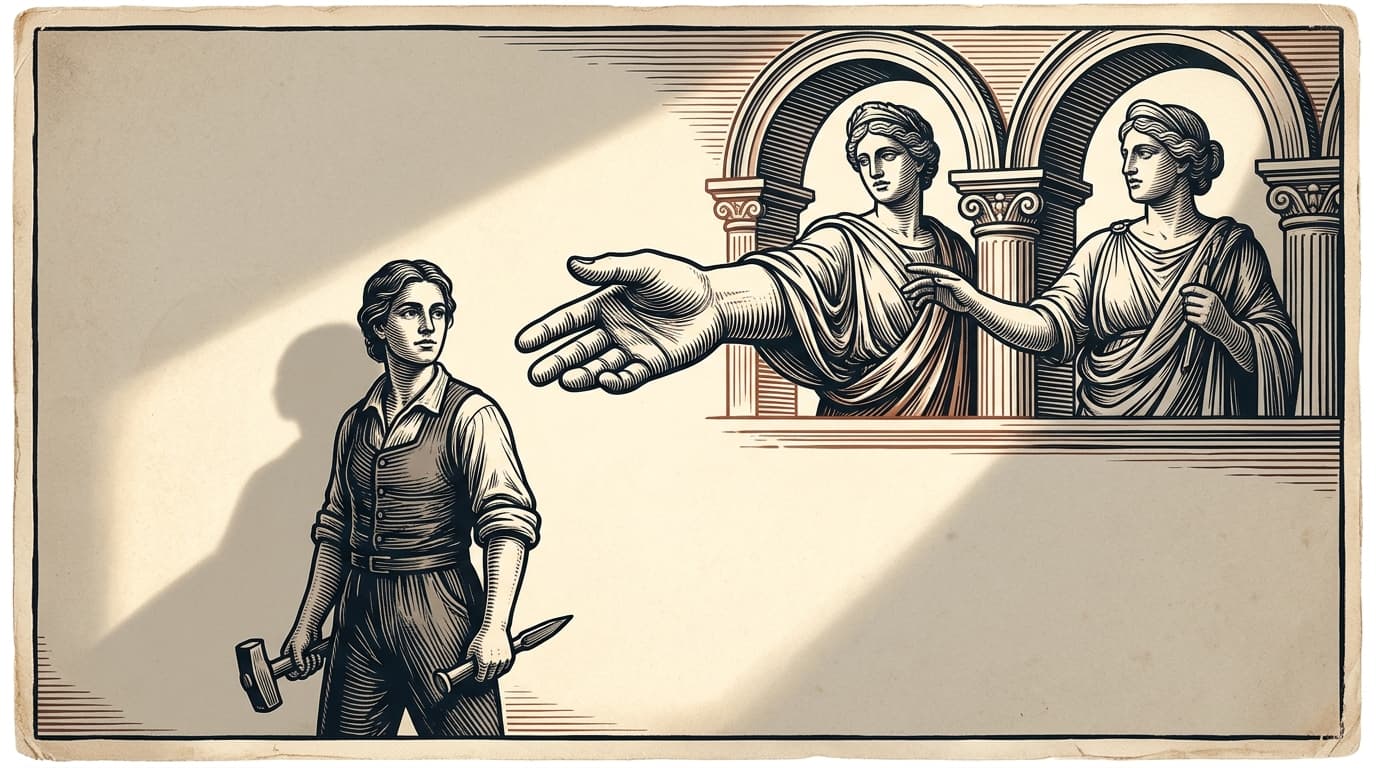
Two mirrored falsifications
Start with an electoral puzzle. In the state of Rio de Janeiro, which Jair Bolsonaro carried in 2022 and Flávio Bolsonaro won again in the 2026 run-off with 53.10% of the vote (G1), Lula's strongest bastions in the capital were not the working-class suburbs of the West Zone. They were the affluent, heavily credentialed neighbourhoods of the South Zone: in the Laranjeiras electoral district, Lula won 64.7% of valid votes in the first round of October 2026, after taking 65.7% there in 2022. Why do voters in the richest cultural enclaves of Rio's South Zone move so fervently to the left, while millions of informal workers, small shopkeepers and family farmers vote for the right?
Part of that South Zone vote is straightforward democratic principle: a refusal of a far-right movement that attacked universities, threatened public-health scientists, and flirted with coups. I share that refusal, and I don't want to cheapen it. But alongside that principle sits a status rivalry within the elite itself. The upper tier of modern society is split between those rich in economic capital (industrialists, merchants, financiers, large farmers) and those rich in cultural capital (academics, artists, journalists, senior civil servants). Lacking the brute power of big money, part of the credentialed elite claims superiority on another currency: taste, refinement, moral vanguardism.
In that milieu, a progressive vote can also work as a badge of distinction. It signals that its bearer floats above the vulgar calculations of the shop counter. And it allows one gesture of contempt to hit two rivals at once: the businessman, imagined as morally brutish, and the conservative worker, imagined as culturally backward. That is megalothymia at cost price, without giving up a cent of comfort.
The mirror on the populist right is no less vain, and when it held state power, its violence was far more direct.
On 30 April 2019, the then education minister, Abraham Weintraub, told O Estado de S. Paulo that he would cut funding for federal universities that, "instead of trying to improve academic performance, are making balbúrdia" (a racket, a shambles). Three universities immediately had 30% of their discretionary budgets frozen (the money that pays for water, electricity, lab reagents and campus security) before the ministry, unable to defend the arbitrary targeting, extended the freeze to every federal university in the country.
Two and a half years later the target moved from lecture halls to vaccine laboratories. In December 2021, while the national health regulator Anvisa was assessing covid-19 vaccines for children, the president said in a live broadcast that he would publish the names of the technical staff responsible. The agency's head, Antonio Barra Torres, counted around 170 threats against staff and their children. And that contempt came down to Sunday lunch. The agronomy PhD student working sixty hours a week on a stipend frozen for a decade, the history teacher trying to show teenagers the difference between a primary source and a rumour, the doctor at the local clinic: all began hearing from relatives and neighbours that they were "indoctrinators" and "parasites who never hammered a nail".
Now turn the mirror back to the educated left, in the words of people it respects. In May 2013, at the launch of a book celebrating ten years of Workers' Party governments, with Lula on the stage, the philosopher Marilena Chauí, one of the most admired intellectuals of the Brazilian left, brought the hall to applause by declaring: "I hate the middle class. ...] The middle class is a political abomination, because it is fascist; it is an ethical abomination, because it is violent; and it is a cognitive abomination, because it is ignorant" ([transcript). Weeks later, she said the line had been taken out of context: her target was the established São Paulo middle class, whereas the millions who had recently risen out of poverty were a "new working class". That qualification is revealing. Those who had climbed were welcome, so long as they remained under enlightened tutelage and did not adopt the aspirations of the floor they were climbing toward.
In April 2022, at a party foundation conference, Lula himself observed that "here in Latin America, the so-called middle class flaunts a standard of living well above what is necessary" (JC/UOL). He was talking about Brazil's obscene inequality. Yet listen to the verbs. The wish of a working family to prosper becomes a moral vice: to flaunt, to live above what is necessary. Who decides what is necessary for a family that has just bought its first car?
The German philosopher Max Scheler gives the sharpest lens for what these two contempts share. In Ressentiment (1912) he separates ordinary envy from something deeper. The envious person still recognises the value she lacks: she covets her neighbour's wealth or learning and suffers for not having it. The resentful person goes a step further. Unable to bear her own powerlessness before a value she cannot command, she falsifies the table of values itself. What escapes me must be rotten; my limitation is crowned a virtue.
Scheler's word is Wertfälschung, value falsification. It is wounded thymos dressed up as morality: if I cannot be recognised for what you have, I will make what you have unworthy of recognition. And to pull that falsification off without blushing, each camp has to replace the flesh-and-blood neighbour whose work or study would command respect with a paper cutout: the "exploiting bourgeois" on one blackboard, the "parasite professor" on the other.
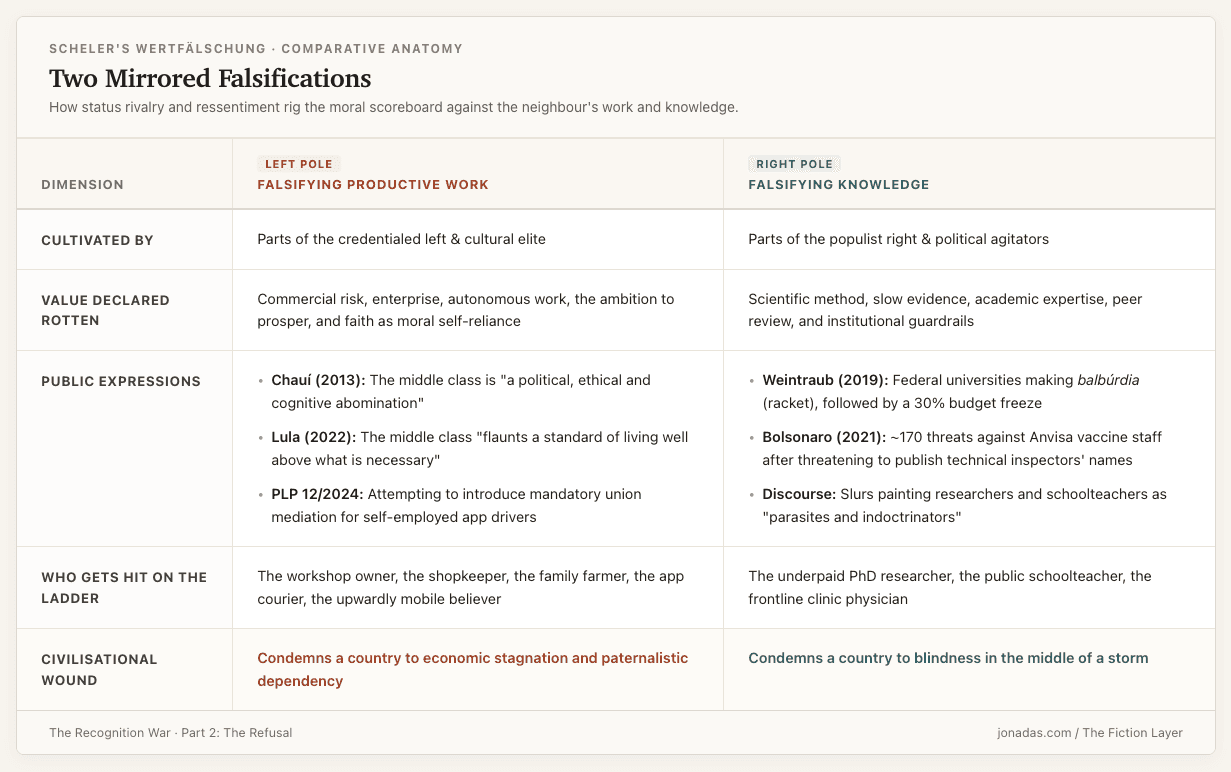
Is it fair to set these side by side? Only if we are precise about where the symmetry holds and where it breaks.
The psychological mechanism is the same. In both camps, a group that feels its worth is under-recognised responds not by competing for the value it lacks, but by declaring that value contemptible. That is what Girard means by doubles: two trenches that think they are opposites, performing the exact same gesture in mirror image.
The damage is not the same. When a political culture treats enterprise, commercial risk and autonomous work as morally suspect, it strangles the practical initiative that generates jobs and income, condemning millions to economic stagnation and state dependency. When it attacks universities, laboratories and the methods by which a society verifies truth, it condemns the country to blindness in the middle of a storm, as the pandemic proved in body bags. Stagnation and blindness are both tragedies, but they are not the same wound, and I will not invent an accounting tie to look even-handed.
Nor are the acts the same. Chauí's sentence and Lula's remarks were words. Weintraub's was an executive budget cut; the threats to Anvisa staff were crimes. Words matter, and a president's words especially. But a country that confused a professor's insult with a minister's freeze would have lost the ability to tell degrees apart, which is part of what this series is trying to recover.
Nor, finally, do I inhabit both pathologies from the same distance. The first I breathed from the inside for two decades of university life. The second I know as a target and an observer.
The refusal to be managed
Girard shows why we target the neighbour one rung away; Scheler shows how we rig the moral scoreboard against him. The Israeli philosopher Avishai Margalit supplies the third step: how that rigged scoreboard feels from underneath, and why the left's promise of protection alienates millions of the workers it was meant to serve.
In The Decent Society (1996), Margalit sets aside the grand question of political philosophy ("what would a perfectly just society look like?") for an earlier, more urgent test: what would a decent society look like? A decent society, he answers, is one whose institutions do not humiliate the people under their authority.
Humiliation, for Margalit, is not hurt feelings. It is any treatment that gives a person a sound reason to consider her self-respect injured. Alongside overt cruelty, he singles out a quiet, well-meaning form of humiliation that progressives routinely overlook: treating adults as children.
Paternalism humiliates, even when it means well. When a state, a party or an intellectual vanguard tells an adult worker that he does not understand his own interests, that his faith is brainwashing, and that his work needs enlightened supervision, it is not practising solidarity. It is revoking his standing as a moral agent. It wounds isothymia while congratulating itself on its compassion. To manage people for their own good without feeling ashamed, you first have to flatten the stubborn complexity of their lives into a neat category in a policy brief. That key unlocks three electoral puzzles where Brazil's recent votes bent the classic materialist arrow from income to ballot.
The farm. Nova Santa Rosa, in western Paraná, is a town of mechanised family farms tied to agro-industrial cooperatives and global supply chains. There are no vast idle estates there, no telenovela colonels. In the 2022 run-off it gave Bolsonaro 85.7% of valid votes. Three quarters of all rural establishments in Brazil (76.8%) are family farms according to the IBGE Agricultural Census (Censo Agropecuário 2017), and in the South those farms are capitalised commercial enterprises, not subsistence plots waiting for state tutelage.
Illegal deforestation and land-grabbing on the Amazon frontier are real crimes, and predatory actors in Congress routinely hide behind the moral shield of the small farmer to weaken environmental law. Yet picture one of those southern farmers watching Jornal Nacional on 25 August 2022, when Lula spoke of "the fascist agribusiness, you know, that is fascist and right-wing, because the serious businesspeople who work in agribusiness, who trade abroad, those don't want to deforest" (Aos Fatos). The line drawn on national television put the giant exporters on the side of the "serious" and left small and medium producers under suspicion. Lula's own agrarian ally Carlos Augustin stated the obvious: "He generalised. I'm going to suggest that he apologise" (Folha). The television slogan "Agro is tech, agro is pop" may be shallow advertising, but it did something the university rarely bothered to do: it pulled the farmer out of Adam Smith's darkness.
The app. Critical sociology quickly christened ride-hailing and delivery riders the "uberised precariat". Yet when Datafolha surveyed 2,800 drivers and couriers across Brazil in 2023 (in a poll commissioned by iFood and Uber), 75% said they preferred to remain self-employed, while only 14% wanted a formal employment contract with fixed hours. At the same time, 89% wanted social insurance against accidents and illness. They did not want to choose between protection and autonomy; they wanted both. When the federal government introduced Complementary Bill 12/2024 (PLP 12/2024) in March 2024, attempting to mandate compulsory contributions mediated by traditional unions without respecting the drivers' ethos of self-reliance, drivers organised nationwide protests and forced the government to withdraw the bill's constitutional urgency, effectively stalling it. A protection that charges the loss of autonomy as its toll does not feel like care. It feels like being demoted.
The periphery. In October 2022, Datafolha showed Lula leading among Brazilians with household income up to two minimum wages by 58% to 36%. Among evangelical voters in that exact same low-income bracket, the result flipped: Bolsonaro led 61% to 34%. Four years later, on the eve of the October 2026 run-off, Datafolha found that religious cleavage wider than ever: while Lula led 56% to 44% among Catholics and 60% to 40% among voters with primary schooling, Flávio Bolsonaro led 70% to 30% among evangelical voters (Folha/Datafolha). Same streets, opposite ballot.
After eighteen months of fieldwork in a working-class neighbourhood in Bahia, the anthropologist Juliano Spyer described the Pentecostal church in Povo de Deus (2020) as a practical engine of community repair. Where the state shows up only as a police car or a hospital queue without a doctor, the church pulls husbands out of drink, calms violent homes, teaches working-class women and youth to speak in public, weaves job networks, and gives the cleaning lady and the night watchman a standing no one can take away. And believers know how the credentialed elite looks at them: in a 2024 Datafolha survey in São Paulo, 45% of evangelicals reported suffering prejudice for their faith, most often at work, in the family, and at school or university. As the left-wing sociologist Jessé Souza concluded in 2024 (Folha), poor voters turned right because in the church "the poor man stops being humiliated and starts being heard." It is what sociologists studying Brazil's peripheries have called "the revolt of the bastards": a politics driven at its core by the refusal of humiliation.
Three ballots, three landscapes, one refusal: to be treated as a stomach without a moral life.
Looking down from where you stand
Go back for a moment to the thumb on the glass.
The sneers that scrolled past on the morning after the vote were transactions of mutual contempt. The professor mocking the "ignorant" farmer and the farmer mocking the "parasite" professor were not, mostly, debating policy. They were reassuring themselves that they were not the other one. Each was pushing down on the rung just below, the one they were most afraid of being mistaken for.
That is the second step of the argument. We despise the neighbour on the adjacent rung; our two camps falsify each other's values in mirror image; and adult citizens punish condescension far more than they reward welfare cheques.
Yet a status ladder is still an individual thing. One person climbs it, one person looks down. What turns my private contempt, and yours, into the mandatory common sense of a whole group, so that decent people who would never insult a neighbour alone find themselves raising their hands in unison?
To answer that, we have to leave the solitary screen and step into a crowded room, late at night, where everyone can see how everyone votes.
Next in the series · Part 3 of 4
The Raised Hand. Why people who think differently in private vote the same when everyone is watching: from the open-vote university assembly to the family WhatsApp group, the permanent feed, and the perception gap that doubles among university graduates.
Followed by Part 4 · What Weighs (Stanley Cavell, acknowledgment, realism, and the forge).
References · Part 2
- Bourdieu, P. Distinction: A Social Critique of the Judgement of Taste (1979; Harvard UP, 1984).
- Scheler, M. Ressentiment (1912; Eng. tr. Marquette UP, 1994).
- Margalit, A. The Decent Society (Harvard UP, 1996).
- Chauí, M. Speech of 13 May 2013 (video; transcript); reply of July 2013 (video).
- Lula da Silva, L. I.: remarks on the middle class, 5-6 Apr 2022 (JC/UOL; Poder360); Jornal Nacional interview on agribusiness, 25 Aug 2022 (Aos Fatos), and reactions (Folha).
- Weintraub, A., 30 Apr 2019 university budget cuts (Estadão; Folha). Threats to Anvisa staff, Dec 2021 (Folha).
- Electoral & sociological sources: Run-off 2026 (G1 state maps); Laranjeiras/Rio vote (Tempo Real RJ, 2026; O Globo, 2022); Nova Santa Rosa (O Presente, 2022); IBGE Censo Agropecuário 2017; Datafolha app workers survey, May 2023; low-income & evangelical vote (A Gazeta / Datafolha, Oct 2022; Folha, 2022; Folha / Datafolha, 24 Oct 2026); Datafolha São Paulo evangelicals, July 2024; Spyer, J. Povo de Deus (2020); Souza, J. (Folha, Nov 2024); Côrtes, M. & Melo, F. B., "Dossiê 'A revolta dos bastardos'", Caderno CRH 34, 2021 (doi).
If you want essays like this in your inbox:
Essays on philosophy, AI and cybersecurity, by email.
Or subscribe at newsletter.jonadas.com.
Related essays